-
Sewing Patterns
-
Fabric
- Sewing Supplies
- About
- Blog
- Gallery
-

We want to say a huge "Thank You!" to everyone who entered out August contest on Menswear. It has been a delight to celebrate Folkwear's 50th anniversary by seeing so many amazing things that our customers make. We had so many great entries and it was very fun to see what you all made and what great sewing skills were used. As always, we were impressed!
In this post I am going to show off some of the best makes we were sent. These are so great and fun, and we hope they provide some inspiration for you!
We will start with one of Folkwear's first patterns, the 102 French Cheesemaker's Smock made by Andrew (we love how many men entered their own makes in this contest).


Shortly after I took over Folkwear in 2016, Kate Mathews, who had owned and run Folkwear for nearly 20 years before, handed me a shirt. She said, "I really like this shirt, but I think it should go with Folkwear. Plus, I think it will look good on you." I loved the shirt and started wearing it, always getting compliments on it when I did. I wore it to our first photo shoot when I was still just learning what all the Folkwear patterns were (and which were still in print). I knew it was from a Folkwear pattern, but I didn't figure out which until after the photo shoot. I was wearing a shirt from the 125 Huichol Wardrobe pattern which had been out of print for many years! I knew then I wanted to eventually bring this pattern back into print. I didn't realize how long that would take!

We stay busy at Folkwear, getting orders out, printing and packing patterns, digitizing and resizing patterns, making samples, testing and making tutorials, etc.. And we have a LOT of patterns! It was many years before this pattern "rose to the top" of the priority list. I also wanted to release this pattern in larger sizes because the original size range was quite small. But grading a pattern like this up to larger sizes when sizes are nested with two size ranges (and for men and women) was difficult. And honestly, the traditional shaping can make grading a little tricky too -- proportions need to change a bit and some parts can't be graded as much as others. And, I wanted to make sure that we honored the history of this pattern, the culture that inspired it, without appropriating their traditional and sacred symbols.
The Detailing in the pattern starts with an anthropological essay by Susana Eger-Valadez who lived with and shared the lives of Huichol Indians for three years, and returned many times over the years. She dedicated her life work to preserving the art and culture of Huichol (pronounced wee-CHOLE), and was founder and director of the Huichol Center For Cultural Survival And Traditional Arts. And, we will be sending a portion of proceeds from sale of this pattern to support this organization.
We included many embroidery patterns from the original, but none that were obviously sacred symbols (shaman, peyote, etc.). These embroidery designs repeat themselves worldwide - and you will find similar designs from Southeast Asia to northern Europe. I love this about embroidery and decorative stitching on garments - they really connect across so many cultures.

The Garments
There are FIVE(!) garments in this pattern: Skirt, Pants, Blouse, Shirt, and Tabard (or open-sided tunic). All are sized for women, and the Pants, Shirt, and Tabard are also sized for men. These are basic garments with a Huichol spin on construction. There are many pleats at the shoulders, cuffs, and waist, and the garments are all a canvas for creativity -- for fabric combinations, embroidery, and trims.
For yardage and sizing charts, including finished measurements, you can look at this PDF document.
The Pants feature a crotch gusset with a slightly dropped crotch. One leg piece wraps to the inside and there are no side seams. The waist is folded down over elastic. You could add a drawstring instead of elastic. These pants are comfortable and have plenty of room to allow movement from work to yoga. The pants fit up to a 57" hip and take from 2-5/8 to 2-3/4 yards of fabric to make. The only notions you need is 1" wide elastic and thread. Add embroidery to the cuff (or embroidered ribbon as I did here).

The Shirt and Tabard are cut from nearly the same pieces. The shirt has a few front pleats with a slightly longer sleeve that is pleated into a cuff. The shirt has an open collar V-neck, and the Tabard has a slit neck that goes from front to back; both are bound necklines. The shirt ends at or just below the waist but the Tabard is a long tunic that ends at the lower thigh (or knee). The Tabard is open at the sides, from the hip down; but traditionally from above the underarm. These fit up to a 56" chest. The Shirt requires 1-1/8 to 3-1/2 yards of fabric, plus bias tape to finish the neckline (and more optional tape to decorate the cuffs and/or bottom hem). The Tabard requires 2-3/8 to 3-5/8 yards of fabric, plus bias tape for the neckline (and more optional to decorate cuffs and/or bottom hem). Embroidery can be added to either of these garments.

The Blouse has the same neckline as the Shirt, but with a lined yoke. A full front and back are pleated into the yoke, which ends just above high bust. Full sleeves are pleated into the shoulders and cuffs. But you can also leave off the sleeves and turn under the edges to have a sleeveless version. The Blouse fits up to a 54" bust; and needs 2 to 3-1/8 yards of fabric.
The full Skirt is pleated into a narrow waistband that is closed at a simple gusset with a hook and eye. The Skirt can be cut from just about any width of fabric, and the pattern teaches a simple and rustic technique for creating small pleats quickly. The Skirt fits up to a 49" waist (and 54" hip, but there is a lot of ease in the hip). For the larger sizes, the waistband has to be cut on the crossgrain and yardage is larger. For 36" wide fabric, you will cut 3 panels of the skirt, but for 45" or wider fabric, you just cut 2 panels.

The Embroidery and Trim
The pattern includes an 8-page Lore and Detailing which starts with Susana's essay on the Huichol wardrobe. The techniques for detailing follow on how to make handmade bias binding (which can be used to decorate edges as well as bind necklines). And, the embroidery, which is done with waste canvas or even-weave fabric, and is a basic cross-stitch. However, Folkwear also added a Slav Stitch (or Long-Armed Cross Stitch) and Bargello Stitch, which can be used in the designs. We include eleven border designs, four animal designs, and a bargello pattern. Use these, or your own, to add color and art to your garments!


Menswear doesn't get nearly enough love in the sewing world. Dresses and blouses tend to get all the attention, but sewing for men, and sewing by men, is important and wonderful. And we've got the patterns to prove it! Folkwear has been designing patterns for men from the beginning (102 French Cheesemaker's Smock and 204 Missouri River Boatmans' Shirt are two of the first patterns).
That's why this month, we're running a Menswear Pattern Contest. We want to see what you've made! To show off your creations and inspire others who sew.

HOW TO ENTER
Folkwear has been making patterns for 50 years, so we're opening this up wide. Show us any men's garment using a Folkwear pattern — a brand new or one you made decades ago, it all counts. Take (or find) a photo and email it to info@folkwear.com before the month ends.
WHAT YOU GET
Whether it's a first-time button-down (212 Five Frontier Shirts), a tailored jacket (133 Belgian Military Chef's Coat) you've been perfecting for weeks, or a men's garment you made back in the 80s, we want to see it. Fifty years of menswear patterns deserve their moment, and so do you.


Email your photo to: info@folkwear.com
Happy sewing,
The Folkwear Team

This essay is by Susan Dworski, a long-time Folkwear customer and fan. She shared her words and photos to provide inspiration and enjoyment. We provided some editing, but Susan provided all the details and photos. Huge thanks to Susan!
My Folkwear journey began in 1976 with the 201 Prairie Dress. Soft, chocolate brown cotton sprigged with tiny blue roses, knife pleated, button front bodice edged in crochet lace, polished off with a lace apron made from an old curtain. Laura Ashley was all the rage in the UK, as were communes and back-to- the-land movements here at home. I kept that dress for 49 years. It survived a house fire that burned everything to the ground, and three more moves, finally gifted last year to a slender young friend who is just starting out on her journey.


A stash of brilliantly-colored, reverse-applique Kuna Indian mola patches had been nagging at me for years. Created by young girls as sewing samplers, later sold for pennies lo tourists, they feature relentlessly cheerful birds and monkeys in unambivalently tropical habitats. What could be more inspirational during dark, January days?

When a friend donated a few yards of African polished cotton from Mali, boldly printed in ochre diamonds on black, I set about inventing a garment for her, using Folkwear 129 Hapi and Haori, that would combine these equatorial textiles into something suitable for Lummi-wear. I even had enough to make a bonus mini bag.


QUILTED KUNA KIMONO
Another blazing, reverse applique Kuna Indian mola had been calling to me while I completed the first African Kuna Kimono seen above. The incredible, tiny patches and miniscule stitches that hold it together in one, precision quilt arc superb. I gathered the components. The embroidered bird patch on the inside of the neck is a sewing sampler from Santiago Atitlan in Guatemala. The outside back called for handmade piping. The sleeves required some patching since I measured them incorrectly... twice! Figuring out the neckband was hard, but once I added pleated trim and some soft stuffing inside the interior of the band I was cooking! The sleeves were complex in and out, but worth it. Thi is also based from the 129 Japanese Hapi and Hoari, but 112 Japanese Field Clothing Hippari would be similar.


The neckband being finished, and finished (above).

I added tiny crystal beads to sparkle up the neck yoke.

I added side vents and facings, which was great because I was short of the lining fabric.


KIMONO VEST: MARCH OF THE INDIGO GUINEA FOWL
"Maybe you can do something with these navy blue birds," my friend D said as she handed me a length of African printed cotton with guinea fowl marching across it. "I bought it in Rwanda years ago." The fabric languished in my basket of blues until recently. After months of pondering, I decided to use it to make a quilted 118 Tibetan Panel Coat. All over sub-Saharan Africa, stylish guinea fowl are tromping across the savannah decked out in polka dots and turquoise chin wattles, herding their keets. Known as inpangela, or, "one who is in a hurry," the guinea hen is a symbol of industriousness. In keeping with this daunting bit of natural history, it should have come as no surprise that crafting the vest starring these birds would be a bit of a challenge.


I shorted the vest to be able to work with the fabric panel. The addition of a cross stitched cell phone/ hankie pocket made from an antique linen tea towel lowered the decibel level of the chattering Japanese faux indigo calligraphy a notch. The inside features a noisy, floral calico interior patched from salvage shop kitchen curtains. An old Americana hand quilted patch enlivens the otherwise sedate outside back. And as ever, the end game mandates the most niggly workarounds. The final corners, points, ends and hems require a thimble and some nimble needling... and a quiet moment.


THE PINK VEST
There are three things I know for sure about my super-talented friend, she loves anything vintage, the color pink, and L'il Buddy, her cat. Everything came together in a perfect storm when I discovered a length of printed cotton featuring a witty, feline riff, combined with some unfinished, vintage quilting strips from Ragfinery, a length of antique striped men's shirting, and an old pink and white checked farm tablecloth. The shortened 118 Tibetan Panel Coat is back in action. I quilted this, made it reversible, added a hidden pocket, and a front tie.


We were excited to re-release the 214 1927 Tea Frock pattern this month. It is a treasured Folkwear pattern to create the iconic, drop-waist, relaxed, informal dress from the 1920s. Our pattern offers 3 sleeve styles (long-sleeve, flutter sleeve, or sleeveless), collar option, smocking option, and embroidery and threadwork designs to add to multiple places on the dress.

In the June 15, 1927 issue of Vogue, the editor proclaimed, “We don’t like the normal waistline, and we don’t wear it. It isn’t so flattering to hips that are none too slim, and it isn’t so youthful.” The lowered waist, and relaxed form of this dress (as well as it would have been an informal dress) allowed the wearer to forgo corsets.
Since then, the fashionable waistline has returned to the place that nature put it, sometimes quite rigidly (1948-52), but usually with an easy, comfortable fit. Today of course, designers feel free to move one’s middle up or down or dispense with it altogether.
Our Tea Frock pattern is softly feminine, infinitely wearable. The original garments in our collection, from which this pattern came from, are made of fine pastel gauze or voile, hand smocked and embroidered in the Philippines. “Peasant look” embroidered dresses with similar cuts were also imported from Romania, Czechoslovakia, Hungary, and France in the late 1920s. Many of these dress featured local, traditional handwork techniques.

A variety of hemline lengths found on dresses of this exact construction suggest that they were popular over a number of years. The versatility offered by interchangeable sleeves and the optional collar makes the Tea Frock practical for summer or winter in soft fabrics. You can also adjust the smocking on the waist or sleeves to be wider, if you wish. And the smocking can easily be switched to shirring to make an easier (and quicker) to sew version (as we did in the long sleeved dress below).

We also really love that the bodice can be made into tops. To make a top from this pattern, all you need to do is leave off skirt (or waistband) and make a narrow hem at the bottom of the bodice. I made two tops, one with the sleeveless version -- no collar and no sleeves, and one with the flutter sleeves and collar.


We are happy to have this classic, vintage Folkwear pattern back in stock! And we hope you enjoy the 214 Tea Frock and all the variations you can make from it.

I am picking up here where we left off for finishing making the 149 Norwegian Busserull. For Part One, which includes sizing, fabric selection, and getting through the placket of the Busserull, see our blog post here.
COLLAR
If you prefer, you should interface the Collar before starting. You can cut interfacing to be one half the size of the length of the Collar and apply it to one side of the collar. Interfacing can help provide more stability for a lighter weight fabric. It also provides some stability for the buttonhole in the collar. I did not use interfacing for my shirt collar, mainly because my fabric was a heavier weight fabric and pretty stable.
Press under 1/2 inch (13mm) seam allowance on one long edge of Collar (if interfaced, press the long edge of the interfaced collar).

Then, with right sides together, fold the Collar on foldline (middle of length of the Collar). Stitch the short ends, trim corners, turn, and press.


We have another fun contest to celebrate Folkwear's 50th year! Over the years, we have heard from many customers who have collected Folkwear patterns. The cover illustrations are iconic and I often hear from people how inspirational they can be -- even if the pattern never gets made. And after 50 years of patterns, with over120 patterns that have gone to print, a large collection can be understandable!
So we want to see your Folkwear pattern collection! Email us a photo or post a photo to social media (and tag us so we see it!) of your Folkwear patterns. Let us know how many you have in your collection. Bonus for telling us which are your favorites!
The contest goes for the whole month of June. We will pick a random winner and a winner with the largest collection to get gift certificates to our shop. And, EVERYONE who participates gets a coupon code to use in our shop. So, send on your photos!
Email info@folkwear.com
Or tag us on Facebook @folkwearpatterns or Instagram @folkwearsewing.patterns
We can't wait to see your patterns and hear your stories!


by Molly Hamilton
This tutorial will show you how to make our newest pattern, the 149 Norwegian Busserull. I am breaking it down into two parts: part 1 includes the preliminary steps through sewing the front placket; part 2 will be sewing the rest of the shirt.
This folk work shirt is boxy, comfortable, and easy to sew. It has underarm gussets, a front placket, and short cuffs and collar. If you want to learn more about folk work shirts, read our blog post about them here.
The busserull is a traditional Norwegian work shirt, often made of striped red or blue fabric, but also made with solid linens or even plaids. Over time, this shirt took on meaning as an identifying symbol of Norwegian identity, and eventually became commonly worn in festivals as well as for everyday wear.
Suggested Fabrics
We suggest using a medium to light weight cotton, linen, hemp, or wool (or blends). But you could also do this in a lightweight denim. A chambray or linen would be elegant. Traditionally this shirt is made in a blue or red fabric (same color as Norwegian flag) with small white stripes. Our yardage charts show yardages for 45" or 60" fabric, so if you get a narrower fabric (as I did with this tutorial), know that you will need more fabric.
I used a red handloomed cotton with white stripes that was medium weight. This is a traditional color and type of fabric for this shirt. My fabric was only 30" wide, so I used an extra yard of fabric.

Notions
You will need thread to match your fabric and six 1/2" (13mm) buttons. If you are adding the back belt, you also need two 1" (2.5cm) D-rings or one 1" waistcoat buckle.
Sizing and Yardage
You can see the sizing and yardage chart here. If you are between sizes, you can grade between the sizes -- going from size LG at waist to size XL at hips for instance. Just make a smooth line between the sizes. The shirt, similar most folk work shirts, has a boxy fit and is meant to have a bit of ease. There is also extra room at the chest from the underarm gussets. If you are very small or don't need or want extra room in the chest, you can make the shirt without the underarm gussets (the last page of instructions in the pattern explains how to do this).
You can lengthen or shorten the body of the shirt at the hem. The front and back are cut as one piece so you need to lengthen or shorten the same amount at each end. If you adjust the length be sure to transfer the squares at the side seams to a new location (based on how much you lengthened or shortened). The squares mark where the shirt is left open below for "tails". You can lengthen or shorten the sleeve right in the middle of the sleeve, or at the hem. If you adjust at the hem, again move the pleat markings and squares.
You can also lengthen or shorten the front yoke. Again, transfer markings if doing so.
If you lengthened or shorten any pattern pieces, you may need to adjust the fabric requirements.
I made a size Small for this tutorial. And as I mentioned above, I had to use extra fabric to cut out my pattern because my fabric was 30" wide. I used 3.25 yards of fabric.
Seam Finishes
You can finish your seams in several ways. Turning the edges under and stitching is an option. Bound edges would be ok if using thick fabric, but is probably not likely for this pattern. You can even flat fell, or faux flat fell your seams. The easiest thing to do is to zigzag or serge your seam edges. I serged most seams.
Cutting
Use the cutting guide and layouts in the pattern, but also know that you can change it up as you see fit. The cuff, collar, and belt pieces can be cut on the cross grain if desired. And the placket pieces could as well, if needed. The sleeves are cut on the fold. And the front and back of the shirt, as well as the yoke, are cut as one piece with a hole cut for the head opening. Don't cut the front slash for the placket yet, but do cut the hole for the head. I like to trace the hole first and then remove the pattern piece and cut the fabric.


For the belt, you should add at least 3 inches to the Left and Right Belt pieces if you are cutting a XL to 3XL size. However, you may want to adjust the length later -- when you are putting the belt on the shirt. The belt is optional, so you can leave it off all together if you want.
Be sure to add markings to all your pattern pieces. I find that I like to mark the notches, circles, stars, etc. on the right side of the fabric (though for this one, I started with marks on the wrong side and transferred to the right side).

Sewing the Busserull
YOKE
Press under the 1/2" seam allowance on long un-notched edges of the Yoke Lining.

Then place the Yoke Lining on top of the right side of the Front/Back, with the wrong side of the Yoke Lining to the right side of the Front/Back. Line up the center back notch, shoulder lines, and front neck slash marks.

Baste within the seam allowance on the sleeve sides of the Yoke Lining and Front/Back. And edge stitch at the pressed under edges of the Yoke Lining. Then, stay stitch about 3/8" (9.5mm) from the neck edge. This helps keep the neck from distorting before the collar is attached.

Cut along the center front opening on the Front and Yoke Lining, from the neck edge to the center of the box. Cut through all layers. I like to mark a line from the neck to the square so insure that I cut the slash accurately.


PLACKETS
Place the long edge of the Underplacket (D) over the righthand edge of the center front opening with the wrong side of the the Front to the right side of the Underplacket. Match the small dots. Stitch from the neck edge to the small dot. This is a 3/4" (19mm) seam allowance.
Now move on to the Placket Piece. With right sides together, fold Placket E on fold line. Stitch around the lower edge, from the fold to the star. Clip off points to reduce bulk and then clip to the star. Turn right side out and press.


Place Placket to the left of the center front opening with right side of the Placket to the wrong side of Front. Match the raw edges. Pin and stitch the the raw edge of the Placket to the Front along the stitching line, from neck edge to star. This is also a 3/4" (1.9cm) seam.


We had a wonderful group of entries for our April Contest - Embroidery and Handwork on Folkwear patterns. Folkwear is known for (and founded on) the handwork details that can go into a traditional or historic garment. Many folk garments are embroidered -- for decoration and meaning -- and the the handwork can place the garment in a time and location. And Folkwear patterns are also used by art-to-wear makers who create amazing garments, incorporating traditional and modern textile arts to create unique and beautiful pieces. A Folkwear pattern is a canvas for creativity.
I am going to show off some of the entries for this contest because they are beautiful and inspirational. A huge thanks to everyone who sent in an entry! You are a talented group!
The 101 Gaza Dress is well known for the embroidery on the front. The gown is traditionally called a thobe and has distinctive Palestinian embroidery decorating it. Customer, Amy, used Folkwear's pattern to add to the bodice. And, Mary sent us this tunic she made (second below) from the 101 Gaza Dress in March.


Another pattern that has a lot of embroidery designs included is our 107 Afghan Dress. While some customers use our embroidery designs, this dress lends itself very well as a canvas for creativity. We had several stunning entries of the Afghan Dress.
Carolyn made the dress below many years ago, spending 200 hours on the embroidery and beading of the front and back panels, plus the fringe. Stunning!


Folkwear has a number of patterns for traditional folk work shirts, also sometimes called smocks. And our newest pattern, the 149 Norwegian Busserull, is another example of a traditional European folk work shirt. There are a lot of similarities among folk work shirts around the world. I define folk work clothes here as the traditional style of clothes worn for working in a geographic or cultural region. The style, construction, and design of clothes are passed down through generations and not usually taught in any formal education. Folk work shirts are based in traditions that are hundreds, if not thousands, of years old. And they were/are constantly evolving. Folkwear was founded on providing patterns for these clothes, and we have several traditional European work shirt patterns from the 19th and 20th centuries, as well as work tops from Ghana, Japan, and Mexico. Similarities in function and construction can be seen among these patterns and garments.
Loose and Comfortable
First, the work shirt, or smock, is meant for working, which means it is generally a loose-fitting and comfortable garment which allows plenty of room for movement. They are usually boxy, with wide shoulders, and can often be long in length (protecting the upper thighs). European work shirts are usually fitted at the wrists and neck. This helps keep a person warm in the many cold days of a Northern climate, but also keeps loose ends of the garment from getting caught in anything a person may be working on or with. The Ghanaian smock has no sleeves, allowing for room to move as well as keeping cooler in a warm climate. And Japanese work clothes often have wider sleeves, but the sleeve are usually shorter than more formal garments (again, keeping sleeve ends away from whatever work maybe done). Often these work shirts were made from a medium to heavy weight linen or cotton, but sometimes wool -- fabrics that would hold up well to being heavily worn.


Geometric Pattern Pieces
Another common feature in work shirts is the geometric forms of the pattern pieces. Pattern pieces are almost always rectangles, squares, and occasionally triangles. Folk shirts were usually made from handspun, handwoven fibers, which were often also hand grown and dyed. And if someone was spending all the time and work to make a fabric, it would be wasteful to cut the fabric into too many shapes, especially shapes with curves (like for a typical curved armhole which we now use). You would want to be as efficient as possible with the fabric yardage. These were not fancy clothes to show off wealth or status. You would want as little fabric waste as possible. Folk work clothes were the original "no waste" sewing. Using shapes like square, rectangles, and sometimes triangles, not only keeps fabric waste low, but also gives a sturdiness and strength to garments which is helpful when the clothes are used for working in fields, homes, or trades.

When you explore these patterns, you can also see that, depending on the traditional loom width size, these work shirt pattern pieces were made to the size of the loom width that would have been typical in the culture (or even village). So, the pattern pieces would be made to be the size of the loom, and either have larger seam allowances if the garment needed to be smaller (which you can clearly see in Japanese patterns like the yukata or hapi) or have panels added to the sides to make the garment larger, which you can see in the 116 Shirts of Russia and Ukraine. In West Africa, most looms are 6-9 inches wide, and you can see in the Ghanaian smock that these strips of cloth are sewn together to make the smock (and therefore can be made larger or smaller by the addition or subtraction of panels).

Shoulder Seams
Another feature we often see in a lot of work work shirts is the lack of a shoulder seam. Often, the fabric for the front and back are cut as one piece. In Japan, and other Asian cultures, there is a center back seam, but in many European (and in the Old Mexico Dress (based on the huipil), there is just a hole, or slit, cut for the head to go through. This is true for the Ghanaian smock as well. Instead of a shoulder seam, the European work shirts often have a shoulder yoke. This is an extra piece of fabric that goes over the shoulders, reinforcing the shoulders and providing some extra protection for the fabric during work. You can see this clearly in the 149 Norwegian Busserull, 102 French Cheesemaker's Smock, and 116 Shirts of Russia and Ukraine. Even the 148 Black Forest Smock (German smock) has extra fabric at the shoulders. The 148 Black Forest Smock and 102 French Cheesemaker's Smock do have a type of shoulder seam, but they are on either side of the shoulder yokes.


Underarm Gussets
Another distinguishing factor of a folk work shirt, particularly European, is the underarm gussets. These are usually triangles, or squares, of fabric that are added between the sleeve and body of the shirt at the underarm. This allows for the rectangular pieces of the sleeve and body to be joined and provide more room for arm movement as well as more room through the chest. You can see underarm gussets in 102 French Cheesemakers Smock, the 149 Norwegian Busserull, 103 Romanian Blouse, and 204 Missouri River Boatman's Shirt, and even in 117 Croatian Shirt (where the gusset is becoming a little more elongated and not a square or triangle, and showing how the shirt was evolving to become a more modern version).


Opening for Head
And that brings us to another feature of a folk work shirt. The opening for the head is sometimes created in the middle of the fabric section for the front and back. Some garments have a circle cut from the center of the front/back piece and this is then reinforced with the yolk and a collar. To make enough room for the head to fit, another slit is usually cut down the front of the shirt and several rectangles of fabric are sewn to make a placket. Sometimes this slit is finished very simply, without plackets (like the shirt in the 147 Norwegian Bunad or 123 Austrian Drindl -- both outfits that have evolved into festive wear). The 149 Norwegian Busserull, 116 Shirts of Russia and Ukraine, and 158 Ghanian Smock all are made with a hole in the pattern piece for the body with a placket covered slit in the front of the shirt (Ghanaian Smock is finished without a placket).

Instead of a circle cut for the head, some shirts are made with a slit cut for the head. The slit runs the direction of the shoulders, and another slit (finished with or without plackets) is cut in the front to help make room for the head to come through. The 204 Missouri River Boatman's Shirt is like this. A more stylized version is the 217 Poet's Shirt, which really is a work shirt that was adopted by the more well-to-do poets and upper class. The slit is cut in the fabric for the head and this slit also has a neck gusset at each end, which is a small triangle of fabric (similar to the underarm gusset) that allows more room at each end of the slit and also then reinforces the slit, so it won’t rip open, yet provides enough room for the head to come through.


Handwork
Another feature of folk work shirts that I find really beautiful is the addition of embroidery that is used to decorate the shirts. Embroidery and handwork can provide meaning to the garment, whether that is simply the addition of beauty to a garment that sees a lot of drudgery, or creates a nationalistic or cultural identity, or simply shows off the skill of the women who were often the ones creating these embellishments. Sometimes symbolism in the embroidery, or handwork, had meaning or implications for the work, the location, or the culture -- such as implications for wealth, health, or protection.
Embellishments to work shirts include embroidery, smocking, handmade lace, monograms, and even resist dying. You can also see the way that embroidery, and handwork, done to these work shirts became very important in some cultures. For example, the 103 Romanian Blouse is essentially a simple work shirt, but the classic and beautiful embroidery that decorates the front and sleeves of the shirt became a national symbol and the shirt now represents Romanian culture and identity. And now, the highly decorated Romanian Blouse is usually worn for festivals and special occasions. This is similar for the 221 English Smock. This shirt, at its core, is a simple work shirt with simple pattern pieces, underarm gussets, and a collar. But over the many years it was in use as a work shirt in England, it became more and more decorated with smocking and embroidery. The smocking was practical (at least at first) because it would pull some of the fullness out of the shirt at the sleeve cuffs and around the neck. The construction, smocking, and embroidery became symbols of British farm workers and laborers. And you can see the same with embroidered Mexican and Guatemalan huipils and Ghanaian smocks.


There are exceptions to the typical embroidered, or decorated, work shirt, of course. The 149 Norwegian Busserull and the 102 French Cheesemaker's Smock are both traditionally made of striped fabric with no other decorations, and may both have developed a little later in history than some of the other folk work shirts.
See our collection of folk work shirts and tops from around the world here.
Do you have further questions about folk work shirts? More to add to this general and brief overview? Let us know in the comments below.

We are celebrating 50 years of Folkwear with a series of sewing contests all year. We have been quite busy here at Folkwear over the last few weeks (and will stay that way for a few more), so we are late getting this month's contest announced. But, we are excited to do so because one of my favorite things about Folkwear patterns is that so many of them have options for embroidery or handwork. Embroidery and handwork has been a way of decorating clothes, and providing symbolic meaning to clothes, for millennia.
For this contest, here are the rules:
You can see a few examples of our patterns with embellishment details in them below.


In fall of 2023, Cynthia made this wonderful tutorial on how to adapt View B of the 211 Two Middies into a long dress with long sleeves. This just shows the versatility of the 211 Two Middies pattern - make it with long sleeves, make it into a dress. You can use this tutorial for adapting the pattern to what works for you. Make the short-sleeved version into a dress and you have a great sundress! Make the dress long or short -- it is a great shoulder season staple that way. It’s one of those designs that continues to inspire, no matter how much time passes or what season we're in.
If you’re looking for a project that blends classic structure with room to experiment, this one still holds up. Whether you’re returning to it or discovering it for the first time, it’s a reminder of how a single pattern can evolve into something entirely your own.
Take a look!
---------------------------------------
With fall weather upon us and the promise of much cooler temperatures, change is in the air. Part of this feeling of change comes with the excitement of a change in wardrobe! There is a simple comfort in being reacquainted with one’s old favorite clothes and being inspired to make new favorites as well.
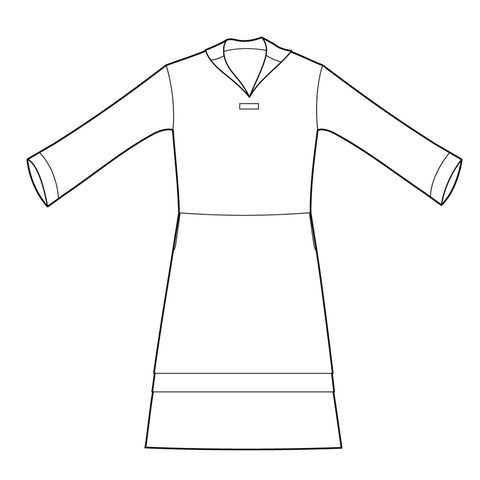
One of the best things about Folkwear patterns is the excellent foundation they provide for making a garment all your own. In this blog post, I am going to show you how I made our 211 Two Middies pattern into a long-sleeved dress!
I turned View B from 211 Two Middies blouse pattern, into a dress perfect for fall! This blouse, with the nautical collar and all its great details, is one of those pieces that is welcome in any wardrobe no matter the season. It is the perfect warm weather blouse with it’s flattering short sleeves and nautical flare. Even if you do not want to make a dress, you can lengthen the sleeves and continue to enjoy wearing the Middy Blouse as the temperature drops. Lengthening the sleeves is easy… just decide on the length you would like and use the “lengthen or shorten here” line marked on the pattern for a warm and cozy version of the Middy Blouse to be enjoyed all winter long. You can also follow along in this blog to learn how.
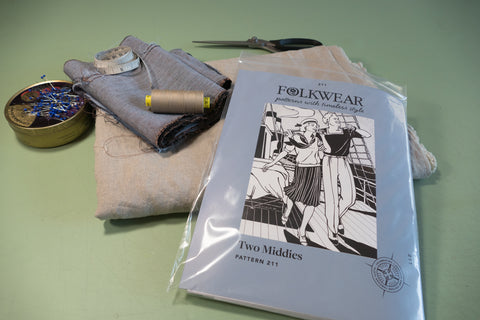
The 211 Middy Blouse pattern, fabric, and thread for making my dress.
The roomy fit of the Middy blouse makes it a perfect candidate for an easy transformation into a comfy dress. The bottom edge of the blouse is made even fuller or wider when the bottom band and little pleats are eliminated. The width of the bottom edge easily accommodates additional fabric for creating a dress.
There are any number of ways of adding a skirt portion to create a dress. The length of the blouse can be shortened or lengthened to change the position of the waistline. It just depends on the look you want and how you want your dress to hang. For a few examples, the blouse could be transformed into a dress by raising or lowering the bottom hem to create an empire waist or a drop waist or somewhere in between. The blouse and skirt portion could be combined and cut as one piece, or the skirt portion could be added separately with gathers or pleats. For this project, I used the Middy Blouse pattern as it is and simply attached a slightly A-line skirt to the bottom edge of the blouse (minus the bottom blouse band).
I made my dress using View B of the Middy Blouse as my foundation with only a few simple changes to alter the fit that allow for a bit of winter layering and a vintage aesthetic. For example, to create a roomier fit, I simply graded the side seams of the blouse to be wider at the bottom edge. To learn how to grade the side seams of the blouse check out the 211 Two Middies Blouse Sew Along: Day Three. The main consideration is being sure the bottom edge of the blouse is wide enough to easily clear your hip measurement to provide a nice hang and give you enough ease of movement.
The other adjustment I incorporated is to make the sleeves longer. I also decided to make the sleeves just a little bit fuller without having to disturb the armhole construction. To do this, I widened the sleeves slightly from the armhole to the bottom sleeve edge.
The blouse becomes a dress when a simple A-line skirt is added. To give the bottom of the dress a bit of interest I incorporated two horizontal pleats. I also added pockets to the side seams, because nearly all side seams are made better with pockets!
All details on how I made these adjustments are below!
Fabrics
I am using a mid-weight linen with a lovely drape and a scrap of leftover linen cross weave fabric for the collar and cuffs. Check out the fabrics for purchase on our website, where you will find some options for this project.
You will need additional fabric yardage for making the skirt portion and for adding length to the sleeves. I added an additional 1 yard (91cm) for the skirt portion and an extra 1/2 yard (46cm) for the sleeves. The fabric I used was 59 inches (150cm) wide.
Note: If you make length or width adjustments to the pattern pieces, be sure to re-check your yardage requirements before purchasing fabric.
Get Started
You will need to make adjustments to your pattern before cutting your fabric or starting to sew the dress.
Adding Length and Width to the Sleeves
The sleeve can easily be made longer or shorter, depending on your requirements. I decided to add width and length to the sleeves.
If you want to add width to the sleeve, do this adjustment first. I made the sleeve 1/2 inch (13mm) wider by grading the sleeve. To do this, I added 1/4 inch (6mm) just to the outer edge of each sleeve side seam, for a total of 1/2 inch (13mm). Remember this sleeve is comprised of a front and a back sleeve piece. Therefore, you do not add any extra width at the connecting center seam. Starting 1/2 inch (13mm) down from the under-armpit seam edge, draw a line connecting to the bottom edge of the sleeve at the added width (in my case at 1/4" wider than the sleeve bottom edge). Use a hip curve to create a smooth connecting line. This is your new outer cutting line for the sleeve. The idea is to widen the sleeve, without disturbing or altering the armhole opening.
After widening the sleeve, I was ready to lengthen it. I decided to lengthen my sleeve pattern to measure 19 inches (48cm) long, keeping in mind the 3/4-inch (1.9cm) cuff to also be added.
I simply cut on the "lengthen or shorten here" line to separate the sleeve into two pieces. Then I inserted another piece of tracing paper behind the two original sleeve pattern pieces, to allow for the increase and connect the top and bottom of the sleeve. Be sure the extra tracing paper is big enough to provide enough overlap on the back side to secure to the original pattern pieces with tape. A bit of tape added to the front side will help as well. Use a hip curve or French curve to create a smooth continuous line connecting the two separated pieces of the sleeve. Trim any access tracing paper away. Now the sleeve pattern has been lengthened and ready to use.
Using Swedish Tracing paper makes this task easy and it can be pinned and reused over and over.

Preparing the sleeve pattern pieces to make a longer sleeve pattern. Notice the graded outer edge.

The front and back sleeve pattern pieces graded and cut apart.

The sleeve pattern pieces separated with more tracing paper underneath to create a new longer sleeve pattern.

The two new longer sleeve pattern pieces.

The new longer sleeves sewn together.
Sidenote: I edgestitched the seams of this dress to add stability to the linen fabric I used. The seams benefit from the stabilization edgestitching provides and this is another way to finish the seam. This is especially relevant if a fabric is not tightly woven (and linen does tend to fray). This edgestitch technique is similar to a faux flat-felled seam, but the seam does not need to be finished together (serged or zig-zagged) so there is a little less bulk in the seam. To edgestitch the seam, press the seams towards the back of the garment and edgestitch on the back side of the seam. I edgestitched the shoulder seams, the sleeve seams, and the waist seam as I constructed the dress. Edge stitching adds a nice finishing detail and strengthens the seams, all at the same time.

The wrong side of the sleeve edge stitched with the seam pressed to the back.

Right side of the sleeve edge stitched on the seam.

The two sleeves sewn together and edge stitched.
Becoming a Dress
I constructed the blouse portion of the dress according the pattern instructions, but left the underarm and side seams un-sewn. It is easier to sew the side seams all at once, after the skirt and pockets are attached.

The blouse portion is nearly complete, except for sewing up the under-arm seams and side seams.
Now to construct the front and back skirt portions of the dress. The skirt I designed is a simple A-line with two horizontal pleats near the bottom to add a vintage touch.
The bottom edge of the blouse determines the width of the top of the skirt portion. The bottom edge of the front and back of my blouse measured 23.5 inches (60cm) wide, therefore the top of the front and back skirt must be the same. I cut the front and back of the skirt with my fabric folded in half, so the bottom edge of the front and back skirt was as wide as my fabric would allow (29.5"/75cm wide or half of the 59"/150cm wide fabric) and the top was 11.75 in.(30cm) at the fold (and 23.5"/60cm when opened).
You can cut your skirt as long (or short) as you want. I wanted my skirt to be a bit longer than mid-calf length, and I wanted to add pleats to the skirt for interest. The pleats meant that I cut the skirt about 4 inches longer than needed, to make two, 1-inch pleats. If you add pleats to your skirt, make sure you make the pleats at the exact same place on the front and back so they match when sewn together.
First, sew the front skirt to the front of the blouse at the bottom hem of the blouse. Then, sew the back skirt to the back of the blouse at the bottom hem of the blouse.
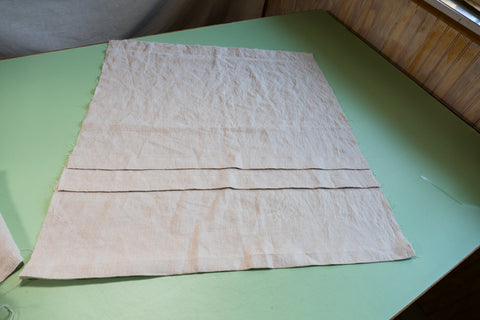
One of the two skirt pieces with its two pleats ready to be added to the bottom blouse edge.

Making sure the horizontal pleats of the skirt align.

The blouse and skirt portions are ready to be assembled.

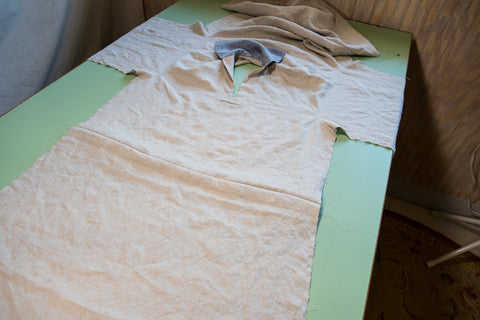
The skirt and blouse pieces sewn together.
Adding Pockets and Sewing the Side Seams
Add the pockets to the side seams of the skirt before sewing up the side seams of the dress. The pockets are optional, but this is a perfect opportunity to try your hand at putting pockets in a side seam. To learn how easy side seam pockets are to make check out the Pocket Series: Side Seam Pocket blog.

Pinning the pocket pieces into the side seams to the skirt side seams.
Stitch the pockets in place first with one pocket piece on the right side of each side of the front and back of the dress. Make sure the pockets are at the same place on each side so they match when put together. Then press the pockets to the outside of the dress and press the seam allowance toward the pockets. Pin the dress side seams and stitch the seam allowance starting the the bottom edge of the dress and sew to the bottom edge of the pocket, being sure to back stitch. Then start the stitching again on the top edge of the pocket and continue up the blouse side seam, pivot at the arm pit and finish stitching at the edge of the sleeve. Then sew the pocket bags together. Repeat for the other side.

The side seam and pocket bag pined and sewn using the seam allowance.
Add the cuffs and little pleats to the sleeves according to the pattern instructions or simply hem to produce the length you require. Binding the sleeve edges would be a nice touch too.
Hem the bottom skirt edge and enjoy your new dress!

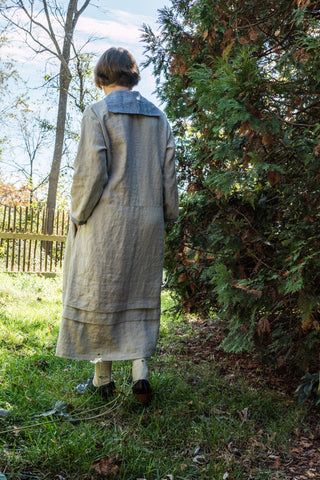

Back view of the Middy collar

Cuff and side seam pocket.

View of the pleat detail.
By using the 211 Two Middies pattern and making some simple changes you can turn this lovely blouse into a whole new wardrobe stable. Learning to look at a pattern with fresh new possibilities is a great way to create new versions of old favorites and enjoy your patterns even more.
We, at Folkwear, look forward to seeing what you are inspired to make!


