-
Sewing Patterns
-
Fabric
- Sewing Supplies
- About
- Blog
- Gallery
-


When we decided last month to feature our 203 Edwardian Underthings pattern, we agreed to make an outfit that shows how the three garments in the pattern can be used to make an outfit that is not just historic underwear. You can read more about how to style these wonderful pieces here.
Three of us in the office (Esi, Cynthia, and Molly) made these three garments from 203 Edwardian Underthings pattern. We chose a beautiful white embroidered eyelet type fabric for the drawers. I think I bought the fabric in NYC Garment District, and was saving it for a project like this (we have several romantic patterns in the Folkwear collection perfect for eyelet). For the petticoat and the camisole, we wanted something a little lighter-weight and the new organic cotton voiles that we carry now were perfect. We chose the lilac and blush colors - so sweet for springtime. They were the perfect weight and sheer-ness for this project!
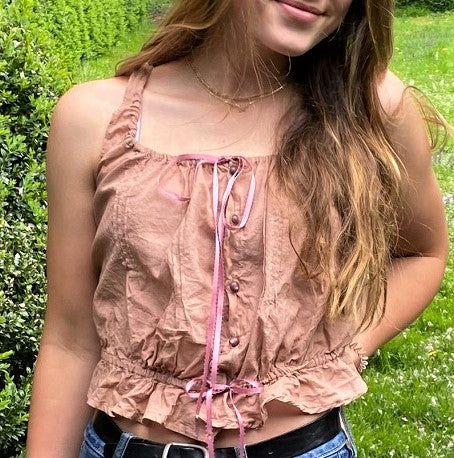
Esi made the camisole with the simple pintucks at the front and small gathers at the waist as the pattern instructs. Instead of eyelet lace or beading at the neckline for the ribbon, she just turned under the allowance to make a casing and threaded a ribbon through. Pretty little rounded purple-pink buttons finished it off.

The next garment to be made was the white drawers made of eyelet fabric. In the pattern, the drawers come to just below the knees, but we wanted them longer. We have seen the trend of these old-fashioned long drawers that look so stylish with every-day tops (and very romantic and chic). Cynthia lengthened the drawers at the hem line of the main pieces, and kept the ruffle the same length as indicated in the pattern. Because she used the edge of the eyelet that was already finished, she did not need to hem the drawers. She made the plackets from a lighter weight white cotton voile. And you can read about how to make the plackets here if you need a little tutorial to help get them done. There is a placket on each side of the waistband. This is a perfect place to put a pocket (if you can add a pocket to a placket), but also a perfect place for a Victorian type pocket.


Hands in plackets (not pockets)

This is a close up of the fabric ruffle. You can see the eyelet fabric edge and how this edges does not need to be hemmed.
Finally, the petticoat was made from the lilac cotton voile. I shorted in the skirt part of the pattern by about 4 inches. And I made the petticoat with the dust ruffle, which is optional. I wanted to add the dust ruffle just to give a little extra body to the bottom of the petticoat. It also makes a fun detail. Because the dust ruffle seam allowance is exposed on the right side of the fabric, you need to sew a ribbon or bias binding over the allowance to enclose it. I used scraps from the camisole to make bias binding to add a touch of color to the inside of the petticoat. I used the method we show in this video to make lots of bias binding fairly quickly and very easily.

The ruffle is sewn to the skirt about 6.5" above the bottom of the skirt and dust ruffle and covers the bottom. There are options to add insertion lace here and/or pintucks. I decided to add the pintucks, which were quite easy. The method taught in the pattern has the raw edge of the hem hidden inside the lowest pintuck. Quite ingenious and easy. As with the dust ruffle, the outer ruffle seam allowance is exposed on the outside of the petticoat. It can be covered with a ribbon for a more decorative finish, but I just made more bias binding from the scraps of fabric from cutting out the pattern.
The waist of the petticoat is just a casing on the inside with a ribbon to cinch. Again, I used bias binding made from the camisole scraps and for ribbon, I used a seam binding in my collection (which worked really well and was a pale pink), but ribbon, twill tape, or handmade bias binding would work well.

Here you can see the pintucks on the ruffle, the dust ruffle underneath, and the bias binding that finishes each ruffle.


These pieces are all adorable on their own, but quite stunning together. I hope you will give this pattern a try! It is sweet.

What is a placket, you might ask? You have seen them and used them before! A placket is an opening or slit in a garment at the waist, neck, or sleeves to help the user put the garment on and off easily. It usually contains some kind of closure for the garment (like buttons, snaps, zip, etc.). The slip of fabric must be contained, or faced, so it looks good and the fabric does not unravel or fall apart. Plackets can vary depending on application - there are plackets used for shirt neck openings, vents, sleeve openings, pant and skirt openings. Plackets are commonly found in tailored shirt sleeves.
Here I am going to show you how to make the placket that is in our 203 Edwardian Underthings Pattern. This pattern has a petticoat and drawers that result in a beautifully finished opening. The plackets make the petticoat and drawers easy to get in and out of, and are authentic to the time period when zippers were not used or common. The petticoat has a placket in the center back seam. The drawers have plackets at each side seam of the waist for added easy accessibility.
This type of placket creates a continuous binding to the raw edges of the seam opening, resulting in a clean tailored finish that can be used on shirt sleeves also. This design results in a neat-crisp tailored-looking finish that is well worth the effort. This placket design is a handy skill to learn, and the more skills you know, the more options your sewing will have.
It can help to make a practice placket or two before you attempt the placket on your final project. When practicing, and to help with eliminating any confusion, use a fabric with an obvious right and wrong side. This will help prevent getting tangled up.
Take time to prepare the placket so construction will go more smoothly. The placket should be cut precisely on the grain to ensure the fabric folds as crisply and accurately as possible. Carefully mark the fold lines, stitch lines, and the dots for the clipping lines as indicated on the pattern. Use a fine pencil, or other marking tool, to create all the necessary marking on the practice piece to help guide the construction and accuracy. See photo below.

It also helps to use a fabric for the placket that will not fray easily. Try using a finely woven cotton batiste or muslin for your practice fabric.
For these plackets, I prepared the center back of the petticoat and the side seams of the drawers according to the pattern instructions. In getting started it is helpful to know that when the placket is finished, the wider back section with the point will lay and fasten over the front or narrow section of the placket. Have a look at a tailored shirt sleeve as an example.
To add the placket to the petticoat get oriented first: Pin the wider section of the placket to the left-hand side of petticoat or skirt back.
To add the placket to the drawers get oriented first: Make the placket on the right-hand side first, which is identical to the petticoat instructions. Pin wider section of placket to Back of drawers.
Pin the wider section of the placket to the back piece of the garment opening only (as seen below). Place the right side of the placket to the wrong side of the back garment piece, match the box, notches and waist edge. Notice the straight edge aligns with the waist edge. Stitch from the waist edge to the center of the square, using a 1/4" (6mm) seam allowance. Be sure to back-stitch at the waist edge and carefully at the square.
Clip the seam allowance of the garment to the square. Do not clip into the placket. Clipping the seam allowance of the garment fabric, releases the fabric so it will open up and lay flat for easier construction. See the photo below.
Press the seam open or to the back of the garment depending on how you choose to finish the garment seams.

With the garment seem allowance clipped the fabric should relatively flat. Pin and stitch the narrower section of the placket to the other or front side of the garment opening. Be sure to pin the right side of the placket to the wrong side of the main fabric as seen in the photo below. Stitch using a 1/4" (6mm) seam allowance from the square center to the waist edge. Be sure to back-stitch at the waist edge and carefully at the square.

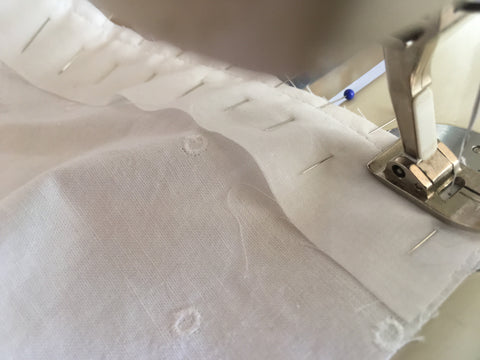
Press the seam towards the placket. Notice that the right side of the placket is facing up and the wrong side of the garment is facing up in the photo below.

On the wider section of the placket, clip the inside of the point to the small dots indicated on the pattern. See the drawn guide line in the photo below.
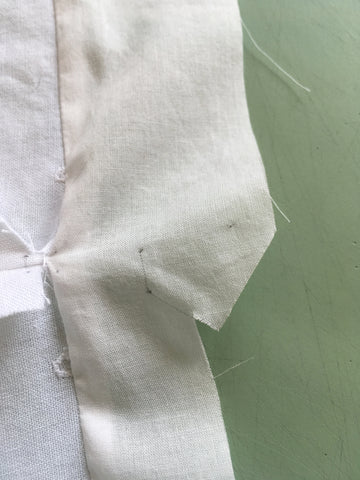
Carefully clipping the guide line, Avoid cutting beyond the dot and into the fabric.

Press the point edges under 1/4" (6mm) creating a crisp and clean finish.

One point edge pressed tuner 1/4" (6mm).

The other point edge pressed under 1/4" (6mm) creating a clean point.

Now, press under the long edges of both sections of the placket using a 1/4" (6mm) seam allowance.
Helpful Hint: To make turning the edges under easier, make a folding guide by sewing a long stay-stitch. Leave thread tails on each end. Once the edge is turned and pressed, the stay-stitch can be easily removed by gently pulling the thread tails. See photo below.

Pressing the edges under 1/4" (6mm).


Turn the narrow section of the placket to the right side to the garment fabric at the seam line and press.

To secure the narrow placket to the garment fabric, pin and top-stitch in place from the waist to small dot on the turned under edge, as indicated on the pattern. Note, the folded outer edge does not require top-stitching.
The two sides of the placket should naturally fold and lay into place as seen below. Note, that the narrow section of the placket falls to the inside of the opening. The wider section with the point falls to the outside of the garment, covering and laying on top of the narrow section. Be sure the edges are aligned as they should be. Adjust the turned edges if needed.


Fold the remaining wider section of the placket, wrong sides together, on the lengthwise center fold line as indicated on the pattern and press creating a clean crisp edge. Pin the turned-under edge over the seam line, using the seam line as a guide. Top-stitch from waist edge to star (as indicated on the pattern), taking care not to catch the stitching in other side of narrow placket underneath.


Pin the pointed end of the placket, over the narrow side of the placket (point will extend below). The idea is to securely stitch the two sections of the placket together at the pointed end.

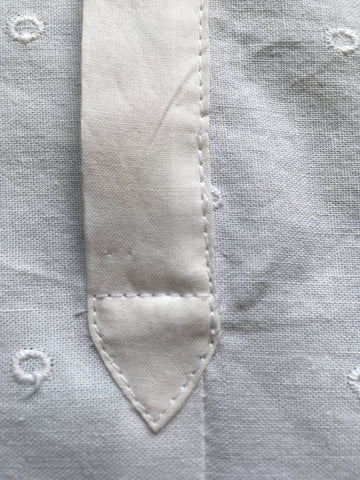
That's it! Placket beautifully made. While learning to make plackets may take a bit of practice, the results are well worth the effort. Plackets are useful and beautiful elements that will elevate any sewing project. Plus, Folkwear has many patterns that are made even more special due to their beautiful plackets. If you need more placket sewing inspiration Folkwear has it covered... check out the 102 French Cheesemaker's Smock, 116 Shirts of Russia & Ukraine, 117 Croatian Shirt, 120 Navajo Blouse & Skirt, 124 Bolivian Milkmaid's Jacket, 128 Russian Settler's Dress, 130 Austrian Bush Outfit,
I hope you found this blog tutorial helpful and please keep as a reference for the next time you need to make a placket.

The Edwardian Era is synonymous with a feminine and charming aesthetic that still stirs the senses, leaving romantic notions in it’s wake. Few eras in history have ever inspired such titles as The Belle Epoche (Beautiful Era) and The Gilded Age. There seemed nothing that was left untouched by the lingering swirl of the romantically bohemian art movement known as Art Nouveau. An appreciation for all things feminine and natural created a blending of influences that would leave a lasting mark on the definition of beauty. This all consuming notion would makes it's mark on nearly everything, including underclothes.
Learn a bit more about the History of the Edwardian Era and the revolution that would change underthings forever in this blog.

There is something irresistible about the diaphanous white underthings of the Edwardian period, whether simple or embellished in delicate lace, that pulls at one’s romantic strings. The 203 Edwardian Underthings Pattern conjures up beguiling ideals of this bygone era that still manages to possess. It would be the addition of lace embellishments that would transform previously everyday undergarments into a new fixating trend called lingerie. Advancements in industrial manufactured lace created a lingerie explosion that resulted in an industry born of a desire for beautiful things, even if they were hidden from sight.

Our 203 Edwardian Underthings pattern consists of three mainstay lingerie pieces of an Edwardian woman’s wardrobe; a camisole (corset cover), petticoat, and drawers. Each piece is offered is in sizes XS-3XL. You can use the pattern to make your own beautiful Edwardian-inspired lingerie, or re-imagine each piece for everyday wear!

The camisole design in this pattern is slightly high-waisted and is fitted in the back, it is bloused in the front, with a soft fullness falling from a gathered neckline. The front of this camisole closes with drawstrings or either ribbons ties at the neckline and waist, and a buttoned front opening. This is a perfectly romantic top, no matter how you wear it, so why not everyday!
For Example:

For a truly Edwardian look, accentuate the bodice of the camisole with clusters of tucks (as indicated on the pattern) and/or add lace insertions. The neckline and armholes can also be trimmed with lace or eyelet edging or just turned under. The pattern also has three crochet patterns to create your own insertion lace and lace edgings.
The gored petticoat in the pattern falls to a wide flounce with a dust ruffle at the hemline. It has a drawstring tie at a back placket opening. The simple design of this piece allows for plenty of embellishment options. Add as many tucks, lace insertions and trims, as well as embroidery touches, as your heart desires (instructions for these embellishments are in the pattern).


However, if you think of this petticoat as a skirt, the options are endless! There is no reason why this pattern would not also make a perfect everyday skirt, underskirt, or half slip… with or without the ruffle.
For example:
Don’t forget the knee-length drawers or “knickers!" These drawers gather at a curved waistband, are constructed with a front gusset and two buttoned side plackets, then finished with a ruffle at the knees. The drawers can also be decorated with tucking and/or lace or eyelet trim or embroidery.

To make the drawers pattern more for everyday wearing:

To make a longer set of drawers, as in the sample above, you can add as much length as you like to the bottom edge of the legs. Even though there is no “lengthen or shorten” line, it is little trouble to add extra length to the drawers pattern. Just be sure to add the exact amount to the edges of both the Front and Back pattern pieces, keeping seam allowances in mind. Lengthen or shorten the ruffle in the same way if you like. Remember, if you use a fabric with a decorative finished edge, like an eyelet or lace edge, lace insertion, or crochet lace for the ruffle, there is no hemming required! The edge is already finished. You can even make the legs full-length with or without a ruffle. A really simple version would be to use a beautiful eyelet fabric that has a decorative bottom edge (like we did with this sample) - and no ruffle is needed!
See the photo below for original lacy Edwardian Era inspiration.

Though the garments in this pattern were originally made of semi-sheer light weight white cotton fabrics, that does not mean they would not be perfectly lovely in other fabrics. Light to mid-weight cotton, linen, silk, eyelet, or cotton flannel would be lovely. The versatility of each of these patterns means they can be made with sheer fabrics for warmer weather, as well as heavier fabrics for added warmth in winter.
Personally, I think layering is under appreciated, and this pattern is perfect for layering. Pair lightweight layers like cotton batiste, muslin, handkerchief linen, and silk haboti underneath heavier weight skirts made of cotton, linen, silks, or wool. This not only extends Edwardian practicality to create comfy warmth without the bulky layers, but makes interchangeable layering fun!
Pairing the camisole and drawers make a fun twist on pajamas! The camisole is perfect for warm weather sleeping, but don't forget how lovely it would be made of cotton flannel for winter slumbering. Make a short pair of drawers for warm weather out of cotton or linen. Make a long pair of drawers for chilly temps out of mid-weight linen, cotton shirting, cotton flannel, or silk.
If you love the clothing of the Edwardian Era as much as we do, you are in luck. Folkwear offers a wide range of garments of to help you find the perfect Edwardian piece for any occasion or just because they are so lovely. Additional romantic Folkwear patterns include the 205 Gibson Girl Blouse, 206 Quilted Prairie Skirt, 209 Walking Skirt, 210 Armistice Blouse, 216 schoolmistress’ Shirtwaist & Skirt, 223 Lady’s Chemise, 227 Edwardian Bridal Gown... plus more!
Shop our lovely spring fabric selection here.
Be sure to see Molly's blog on lace insertion if you want to add lace to this pattern (also instructions are in the pattern). Of course, this tutorial is perfect for making the 205 Gibson Girl Blouse or any other garment that needs an authentic touch of lace insertion.
Whether for your trousseau, cosplay costume, historical reenacting, or everyday wearing our 203 Edwardian Underthings pattern will prove to be an enjoyable and easy to make addition to any romantically inspired wardrobe. Let this pattern stir the romantic in you!
As always, we look forward to seeing what you are inspired to make.


We are excited to introduce you to the pleasures of making and wearing the garments offered in the 108 Turkish Dancer pattern (a pattern we are featuring this month). In this blog we will share a bit of Turkish history, offer fabric suggestions, and tips that can be used for making any or all of the garments featured.
108 Turkish Dancer includes three basic garments that Turkish women often wore combined and layered, creating sumptuous looks that feel totally modern. Included in this pattern, is an Entari or robe, a bodice-shaped vest, and a short jacket. In addition to the collection of garments featured in this pattern, you can create your own extraordinary wardrobe by combining these basics with other traditional Folkwear patterns. The 106 Turkish Coat and the Turkish pants from the 119 Sarouelles will perfectly round out a great outfit.

While the garments in the Turkish Dancer pattern are considered to be the basics of a Turkish woman’s wardrobe, they are not your average basics (read more about the history of the pattern here). Each piece can be made as simple or as lavish as you chose. While each garment is basic and relatively quick to make, it is the beautifully drafted pattern foundation, resulting is a flattering lines and fit that gives you so much to work with. Simple, yet well designed, patterns such as these are a pleasure to sew and wear, providing a perfect canvas in which to let your creativity shine. The pattern fits a broad range of sizes - from XS to 2XL. Each piece can easily stand alone as a statement piece or mix any combination of the trio with a simple skirt, pants, or leggings. Even your favorite pair of jeans will be transformed when paired with any or all of the Turkish Dancer offerings! The pattern also includes extra information, including much more history, lots of traditional embellishment ideas, how-to instructions for different embroidery stitches, and authentic embroidery designs transfers.
The Entari or robe, features optional waist-shaping darts, plunging V-front neckline, button-loop front closures, flowing bell shaped sleeves, and free-floating ankle length panels. Make as a gown to layer under the vest and jacket and/or as a coat to wear on top. While the the length of this design is most dramatic when long and flowy, its versatility allows it to be made any length you chose. Adjust the length of the sleeves or remove them all together to create a sleeveless tunic. Leave out the waist shaping darts and enjoy a more leisurely look and fit - perfect for lounging about!
The unlined, semi-fitted vest has a low-cut curved neckline, curved Princess seams (which makes fit adjustments easy), and button-loop front closures. This easy-to-sew garment can be quickly bound along the edges and lavishly embellished with braid, sequins, machine or hand embroidery, and it right in style with the currently popular mid-riff look.
The short jacket (also called a Yelek or Mintan) has a gently curving front hemline and bell sleeves that fit over the Entari, allowing the Entari sleeves to drape sensuously. This quick-sew garment with bound edges is perfect for elaborate fabrics and embellishments.
Fabric Suggestions
The hardest part in choosing a fabric for any one of these pieces will be narrowing down the options. Each garment offered in this pattern could be made of just about anything, with just a few considerations to think about. Keep in mind how the fabric you chose drapes and the ease of working with certain fabrics when it comes to making binding and button-loops.
Silk would make any of these pieces totally swoon worthy. Just imagine an entire layered ensemble made of beautifully combined silks! Mid-weight linen and handkerchief linen are also ideal and would be perfect for transitioning from early spring to summer wearing. Personally, I think spring is best enjoyed while draped in layers of linen! And, cottons of all weights are always perfect. A combination of cotton batiste, lawn, and voile would be perfect for easy-breezy-summer layering. Of course, these a just a few possibilities. Below you will find more options for each specific garment.
The Entari already has built-in drape due to it’s flowing panels. So just about any fabric will work, but something drapey or with a bit of structure is perfect. Cottons and linens of all weights are ideal. So are cotton velvet or rayon velvet. You could also use rayon, flannel, or even knits with a bit of body, all of which would be nice for a gown or robe. Light-weight to medium-weight wools would be a good choice for a coat or long-tunic-vest if you eliminate the sleeves.
Since the vest is more structured, consider the fabrics weight. Also think about fiber content next to the skin, if you plan to wear it on its own. Of course, it can be worn with a top or blouse underneath. All weights of silk, cotton, linen, velvet, wool, felt, flannel, denim, brocade, satin, suede, or upholstery fabric would work nicely.
The Entari and vest are each finished with bound edges and a front button-loop closure, so see the tips below and in our blog post about making and using bias binding and button-loops.
The short jacket is a piece of cake. Quick and easy to make out of anything - just be sure to make the most of the beautiful drape of it’s sleeves. Because this piece can be worn over and/or layered with just about anything, it can withstand a bit more structure. Using a bit heavier or more tightly woven fabric you automatically give this jacket more structure. Wool, linen, cotton, all come in heavier weights and will work well. Velvet, felt, flannel, denim, brocade, satin, suede, or upholstery fabric are good choices too. For a softer look, a loosely woven or light-weight cotton or linen, silks of all sorts, rayon, knits with bit of body, and lightweight wool challis are examples of fabrics with more drape that would give this jacket an entirely different look and feel. This jacket’s edges are also finished with binding so see the tips below to help make your sewing easy.
No matter the fabrics you choose, keep the layering harmonious. Relegate heavier fabrics for the outer most garment layers. If using light-weight fabrics, consider interfacing the pieces with compatible interfacing before construction.
Fabric Tips for Binding and Button-Loop
When making binding and loops the only rule is to avoid a fabric that wants to unravel. Depending on your experience level and bravery, you may want to avoid fabrics that are slippery or heavy. Lighter weight stable fabrics are much preferred when first attempting to make binding and button-loops. Learn more tips and How to Make Binding and Front Button-Loop Closures.
Because these three pieces go so beautifully together they are perfect of mixing fabric weights, patterns, and textures to create an interesting dynamic aesthetic or keeping things elegantly simple with fabrics that blend subtly. Just keep in mind how different fabrics behave when put together. When layering you want the fabrics to slide against each other enough, to allow for easy getting in and out of and comfortable wearing.
Below are some fabric suggestions from some of our favorite fabric stores. Please note, these suggested fabrics are based on fabrics that are in stock at the time the blog post is written, and may go out of stock from store at some point. If link is invalid for specific product, look for a similar fabric you can substitute.
The textures woven into this golden linen from Stonemountain & Daughter Fabrics are subtle enough to pair with a bolder fabric for the outer layers, yet unique enough to still draw interest. The light weight would suit itself well to the inner-most Entari layer.

Oak Fabrics has a fun and lively cotton lawn option that would make for a more exciting look for the Entari or the vest.

Also from Oak Fabrics is this lovely Russet Stripe cotton flannel. The weight has enough body to be used for any part of the ensemble, and would be beautiful in the jacket.

This cotton canvas from Harts Fabrics is sturdy enough to make for a striking vest or jacket.

For a fabric that would pair nicely with any of our suggested options above, this earthy cotton-linen blend would make a lovely jacket.


by: Cynthia Anderson
There is an allure just in the name of this pattern . . . Turkish Dancer. The sensual lines and aesthetic of the garments seem to tell a hidden story that insinuates a mystique. To fully appreciate this beautiful pattern and to understand it’s origins, you must take a closer look into it’s past.
The making of history is a constant force, but there are times and places when the those forces are so profound, that a cosmic shift seems to occur. This is exactly what happened centuries ago, in a region of the world we now know as Turkey. A perfect brewing of timing, along with the an ideal location, and a plethora of overlapping and unanticipated factors, would create such a powerful and exciting explosive cultural storm, that its sheer impact would maintain its own momentum for centuries. With such a force, it is inevitable that people and the evolution of their clothing would be propelled in tandem as history would be woven. The Folkwear 108 Turkish Dancer pattern represents a selection of garments that come from a blending of multiple cultures over many centuries that is associated with this nexus of history. Turkey’s cultural history became one of the most rich and diverse as any in the world. Due in great part to it’s physical ability to literally connected the east and west, creating a ripe and seemingly ever changing epicenter that would influence a significant part of the world, with an equally exciting and rich array of clothing and textiles to match.
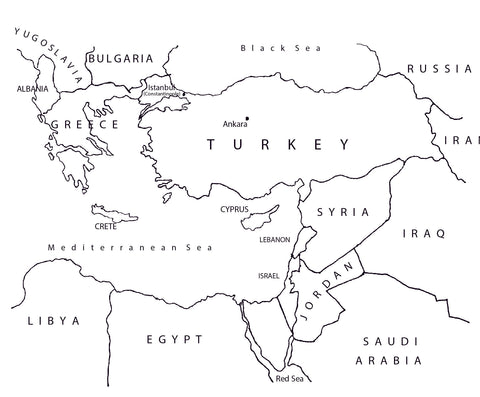
Originally, Turkey was know as Anatolia, which resides on what we know as the Anatolian Peninsula. This outcropping of land is bounded on three sides - the Black Sea to the north, the Aegean Sea to the west, and the Mediterranean Sea to the south. This peninsula served as a natural bridge between Asia and Europe. The orientation of the peninsula resulted in it becoming a central point of trade and therefore saturated with overlapping influences that would culminate over the centuries. One could say that this exchange of cultures, ideas, and goods was one of the first examples of globalization. This long great migration of people would create a fascinatingly diverse place that would influence the world and what it chose to make and wear.
The Turks were originally related to nomadic people of Eastern Upper Asia, and not the Arabs as commonly believed. As the nomads migrated west and south along the trade routes in the Middle Ages, they settled in the rural areas of Central Asia, the northern Arabian peninsula, and eventually the Anatolian Peninsula.
As the Turks gained power in Asia, they infiltrated the Byzantine empire, where they took over more and more territory. After the 6th century the Turks had a dominate presence in Persia (now Iran), Iraq, Eastern Europe, and cemented Anatolia once and for all.
The Turks settled in isolated villages, which ensured many aspects of their inherited Asian cultures were preserved. While at the same time, the proximity of Eastern European and Mediterranean countries influenced and intermingled with their traditions, resulting in an interesting multi-cultural mix. Greek, Roma, Persian, and Arabic cultures had all existed in what is present-day Turkey. This cross pollination of style and design was inevitable. For example, the impact of the geographical closeness of Greece was apparent in the Turk’s Flowing robes, while proximity to the East showed up in the sumptuous embroidery on Turkish textiles.
The Ottoman Empire was formed in 1297 and became the epicenter of Turkish life. By the end of the 14th century, the Ottomans held more territory in Europe than in Asia. Reaching its height in the middle 1500s was marked by advances in government administration, the arts and architecture, and trade agreements with France. At this time, the Ottoman Empire was the largest, strongest, and richest power in the Old World. One can only imagine how interesting and beautiful their clothing must have been! However, as in much of the world’s history, it’s freedoms and resources was relegated to the privilege of men.
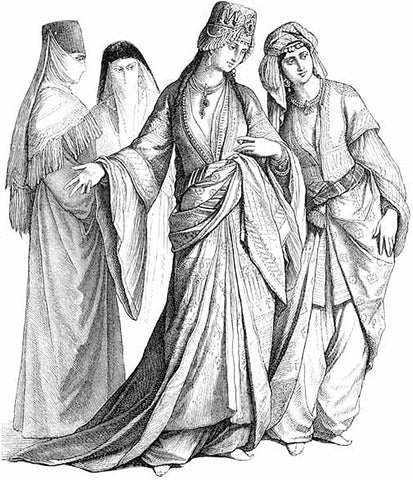
What is hard for our modern sense of freedom to fathom, is that half of this plethora of beautiful clothing and culture was hidden out of public sight during the reign of the Ottoman Empire. Because Ottoman women played no open role in public life they were not free to be seen out in the world. If they lived in cities they were confined in to the walls of their homes. If they lived in rural areas they worked in the fields. Women could earn their own money, as long as it did not require any association with men. Typically, women worked as weavers and embroiderers, either in the home or at professional workshops. (Some of these beautiful traditional embroidery patterns and techniques are included in this pattern).
The lives of men and women were segregated in all aspects of life. Even at home, men had their quarters and women and children had theirs. Depending on their families means, women spent their days supervising the work of servants, caring for children, observing religious customs, playing music, sewing and embroidering family linens, dowries, or goods for sale. Because of the limitations on women’s activities and the boredom (and depression) that inevitably resulted, indulgence in opium smoking could occur.
When women left the house, they were required by Islamic law to conceal themselves according to strict rules, usually in enveloping cloaks and veils. Although the Turks descended from Central Asian Buddhists and were exposed to the more inclusive and the freer thinking religions of China, Tibet, India, and Persia, they adopted Islam by the end of the 11th century. Needless to say, the women were not consulted.
The one freeing indulgence that was acceptable for women to engage in was visiting the public baths. Hamman, as the public baths were called, were important social events for women. At the baths, they visit with each other, exchange news and stories (gossip). They worked together on their needlework, ate, and bathed. Women wore their finest clothes to the hamman, where they showed off their dancing abilities and embroidery skills. These women had no idea that their connection to each other, would still hold true through today - through a Folkwear pattern. It is not hard to picture our pattern and all is variations being worn as these women visited, relishing in time to themselves.
History has lead us to believe that women or “sultanas” danced only for men, the truth is that women danced primarily for each other at home in their private quarters or at the baths. If a woman danced for a man, it was strictly in private for their husband only.
Despite half of the Empire’s population being relegated basically to societal non-participation, it continued on. Because of the Empire’s complex historical and cultural diversity, and great climatic and geographical differences, it is an understatement to say there was a great variation in clothing. The reach of the Empire into the Balkans and North Africa influenced the look of indigenous dress, and customary Ottoman dress was, in turn, influenced by the indigenous costumes of those areas. One can identify many common features of costumes across the Empire, yet the integration of regional characteristics made for a beautiful mosaic of Turkish dress.
As history would have it, even great empires are not immune to decline no matter how long and illustrative their histories might be. The Ottoman Empire would prove unsustainable, due to internal strife and corruption. Outside powers would gain an upper hand, which would exacerbate the loosening grip of the empire. Despite this slipping of power, the decline would last several centuries more before the Empire ended. The Empire finally dissolved upon the close of World War I in 1918. In 1922, the last Turkish sultan was overthrown and modern Turkey was born.
Once again a new storm brewed - changing world factors would create another tectonic shift and send history off into new trajectory, dragging behind it old relics that still remain. The grip of history has changed little for women who still live within these ancient cultural norms. This may also explain why creating beautiful clothing and textiles was such an essential outlet for so many women throughout history. The one constant about history is that it never stops playing itself out and some constructs do change, for better or worse. The important part is to have a better understanding of the past, so we can better reshape the present and future. This is a lot to contemplate, but much of history evolves in the quiet recesses of daily life.
Folkwear patterns are more than just clothing patterns. We hope to inspire and provoke interest in the deeper value of how clothing has helped shape the world. We believe that sewing is made richer and therefore more enjoyable when you understand more about the garments you have been inspired to make - including their histories and cultures. Each Folkwear pattern comes with a past life and an incomplete history lesson, as well as “how to’s” using authentic techniques to not only inspire your sewing, but to also create a meaningful link to the past. Folkwear hopes to celebrate each pattern we promote, with a mindful appreciation of the origins and culture that each pattern represents. Clothing is a beautiful way to link ourselves to others. But, to gain a true understanding and respect of all people, it is equally important to look a little deeper into the truths and realities of history and to see how deeply our own reflection looks back at us in the mirror. The evolution of what we wear rarely happens in a clear linear fashion, but manifests in a twisting sequence of often challenging occurrences, as does life.
The next time you use a Folkwear pattern to make a garment that is all your own, we hope you feel a connection, learn something new, and realize you are helping to keep history alive.
We hope you will enjoy making the garments in the 108 Turkish Dancer Pattern and integrate these basic pieces into your person wardrobe, in your own unique way. As always, we love seeing what you are inspired to make!
P.S. Don't forget to check out the blog where you will learn how to make binding and a front button-loop closure for the Folkwear 108 Turkish Dancer Entari and vest.

by Cynthia Anderson
Learning how to make bias tape for binding is a liberating skill and one every sewist should have in their arsenal. Understanding all the possibilities available to you when faced with any task, gives you not only more options, but added confidence. In this blog you will learn how easy it is to make your own bias tape and how to use it to create a neat and clean finish to any raw fabric edge. You will then learn how to apply this same technique to make a front button-loop closure.
Bias tape can be used to cleanly finish the raw edge of fabric. The raw edge of the fabric is sandwiched between a strip of folded bias tape and stitched together to keep the fabric from unraveling and to create a finished edge. The bias tape is cut on the bias to allow it to slightly stretch and give, making it easy to smoothly go around curved edges. This is extremely important when binding a neckline or armhole. This finishing technique is used in any number of applications, like luggage and handbag construction... but most commonly used in making quilts and clothing.
There are a number of Folkwear patterns that incorporate bias tape binding! For this purpose of this blog, the Folkwear 108 Turkish Dancer pattern is featured. This pattern includes three easy to make and wear basic garments, an Entari (robe), vest, and cropped jacket. All three garments incorporate finishing edges using bias tape. And the Entari and vest both have a front closure made of button loops, using the same bias tape technique. Learning to make bias tape will open up a whole new world of sewing possibilities, and the 108 Turkish Dancer Entari is the perfect piece to entice and inspire you!
You can always purchase bias tape binding. However making your own is not hard, and it saves money, and helps give your scraps new purpose. And your creativity has no bounds!
Making Bias Tape
There are endless schools-of-thought, when it comes to making bias tape. However, the technique used in this video is ingenious and well worth learning, especially if you require copious amounts of binding and have a limited amount of yardage. This technique is also perfect for using up the scraps in your cabbage bin. The discouraging part of making your own seam binding often comes from the toil it takes to create one continuous strip that is long enough to meet the requirements of your project. While making bias binding is not hard, it can be bothersome to not have enough. This video is is a game changer!
Using a Bias Tape Maker
Once a long continuous strip of bias tape is cut to the width you plan to work with, the easiest and quickest way to make bias tape is to use a Bias Tape Maker. This handy tool is easily found where sewing notions are sold and are available in five different sizes; 1/4"(6mm), 1/2"(12mm), 3/4"(18mm), 1"(25mm), and 2"(50mm). We have three commonly used sizes in our shop.
It is important to predetermine the size (width) of binding you intend on using, before you cut any strips. Typically, the pattern will provide you with a recommended width and length. In order for your bias maker to make neat and tidy folded edges, you need to use a strip of fabric that is appropriate size for the size of maker you are using. The width of the small end of the maker is the width your bias tape will be. This small end is half the width of the large end. Therefore, the width of your bias fabric strip should be double the width of the final results. For example, I am making a 1/2-inch (12mm) binding and my strip is 1-inch (25mm) wide. There is a little bit of wiggle room in the width of the strip you use in the bias tape maker tool. It is preferable to have just a hair too much than too less. The idea is for the folded edges to be as even as possible and for the folds edges to barely touch in the middle. If your fabric strips are too wide or too narrow it will not work so well.
I am using a bias strip that is 1-inch wide. Insert the bias strip into the widest end of the the Bias Tape Maker, using a straight pin in the slot on the top of the tool, ease and pull the fabric strip through the small end. See the photos below to see how to get started feeding the bias strip through a Bias Tape Maker.


Keep the strip evenly fed through the wide end. This will help in keeping the folded edges even as the strip comes out the other end. Pull slowly, using the folding handle on the the Bias Tape Maker, pressing with a stream iron, as the folded tape comes out the end. Use the steam of the iron as you go to set the folds of the strip. The Bias Tape Maker folding handle ensures your fingers are as far from the steam of the iron as possible.

The following photos illustrate how to use the Bias Tape Maker in tandem with a steam iron. Of course, you can make your own bias tape, by meticulously measuring, folding the sides toward the middle, and trying to avoid singeing your fingers, but it is not recommended.


Next fold the folded strip in half length-wise and press again to set the fold. This creates the binding, and makes it a "double fold bias tape". Take your time to ensure a nice fold. Ideally, you want to fold and press so that the top edge is ever so slightly shorter than the bottom edge. The idea is that the underneath edge is wider, so that when sewing the binding from the top, the bottom edge gets caught in the stitching. See the photo below.


If required, trim the excess seam allowance according to pattern instructions. In this case, I trimmed leaving 1/8-inch seam allowance before attaching the binding.
Sandwich the raw edge of your fabric in the fold of the bias tape and secure in place using as many pins as needed to hold everything neatly together. Be sure to leave a bias tape tail of a few inches at the beginning and end of the edges you are working on (see third photo below). The tails will get trimmed and turned under in the end.


Using matching thread set the stitch length and tension so it is not too short or tight and not too long either. On my machine the this setting is around 3. Using a regular straight stitch presser foot on your sewing machine, place your work securely under the foot so that the fabric has good contact with the feed dogs. Use the edge of the foot as your stitching guide. In the photo below, you can see I am using the inner left edge of the presser foot as a guide. Position the needle so it aligns as close as possible to the inner edge of the bias tape, but not too close as to not catch the bias tape in the stitching. It might take a little fiddling to figure out what alignment configuration works best for you.

Once you are ready to stitch, take your time and stitch slowly to keep the stitches as aligned and evenly spaced with the edge of the bias tape as humanly possible. The idea, and sometimes the trick, is to catch the underneath edge of the bias tape in your stitching (this is why the tape is folded unevenly, as mentioned above). Often this is easier said than done. In part because you can not see the underneath of the fabric and the margin of error is hard to control. Do the best you can, knowing that it is highly likely that the underneath edge of the bias tape may have not gotten ALL caught in the stitching. It is ok. Simply enjoy a little hand stitching to secure the spots that were missed. You want to make the top of your bias tape stitching as neat as possible. This is the side that shows and therefore the only side that really matters. Remember, perfection can take the pleasure out of sewing.

To finish the raw ends of the bias tape edge, trim away any excess, leaving enough turn under the edges of the bias tape according to the pattern instructions (usually 1/4-inch). Using your fingers or pins to hold the folded under edge in place, use a simple hand whip stitch to secure neatly into place. There are times when only hand stitching gives you the control you need. Below is a photo showing the pointed edge of the Entari sleeve hand stitched to finish. Notice how the binding is turned under and meets at a neat finish.
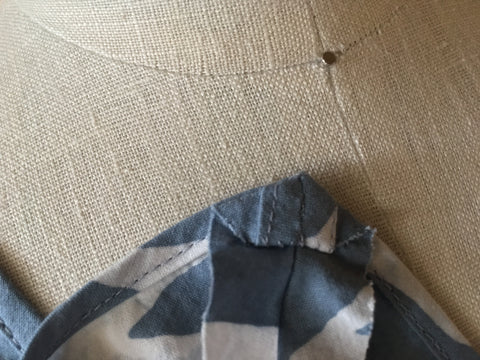
That's it bias tape made and edges beautifully finished.

Neck line edge finished.

Sleeve edge finished.
Making the Front Button-Loop Closure
This same easy bias tape technique is used to make the front button-loop closure for the Entari (robe) and vest featured in this pattern. These techniques are not exclusive to this pattern, but can be used on any garment that needs an interesting closure or a simple finishing detail. Not only is this perfect as a front closure, but works beautifully for a front or back neckline detail, a sleeve or cuff closure, a vent detail, or anything else you can dream up.

Bias Button-Loops Tips and Techniques
When making binding and loops the only rule is to avoid fabrics that want to unravel. Depending on your experience level and bravery, you may want to avoid fabrics that are too slippery or heavy to start with. Lighter-weight stable fabrics are much preferred when first attempting to make button-loops out of bias binding.
When making your own binding for button loops, consider how large or small button-loops need to be. This will in part depend on the size of the buttons, how many buttons, and spacing of the buttons and loops. Logically... small buttons will function and look better with small loops. Large buttons will need larger loops and more space.
Aesthetics and personal preference plays a part as well. The pairing of buttons and button-loops is an opportunity to get creative. Consider how much you want this detailing to stand out or fall back. Make the most of of the details in anyway that you choose.
As before, the fabric will need to be cut on the bias, in a fabric with a weight that will allow the fabric to nicely fold in on itself... just like we did with the edge binding. The bias cut will also allow your button-loops to bend and loop smoothly. By keeping your binding and button-loop fabric choice relatively light-weight will help avoid bulk and ensure ease of making, especially if you are working relatively small, as I am with this project.
Make the binding tape as you have already learned to. Fold the tape evenly, with the edges matching this time, and press to create clean edges. Pin to hold the fold securely in place with as many pins as deemed necessary. See the photos below illustrating these instructions.


Stitch as close to the edge as possible, being sure the top and bottom edges are caught in the stitching. See the photos below.


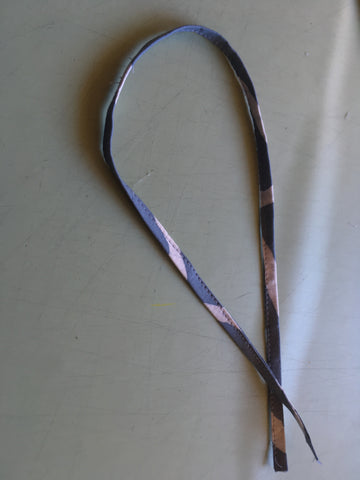
Now, that the binding tape is sew together, cut out the number of loops you need in the length needed, or according to the pattern instructions. You need to determine what buttons to use and their spacing out ahead of time.

Make a loop out of each cut strip, keeping the stitched edge turned to the inside of the loop. This detail simply makes for a cleaner looking loop. Be sure that all the loops have the stitched edge situated in the inside of the loop.


With each stitched inner edge of the loop touching, machine stitch each loop together approximately 1/2-inch (12mm) in from the raw edges. Sewing the loops together now will eliminate fiddling with trying to place them later.
Give the loops a bit of a study and take notice of what is the the right and wrong side of each loop. The loops in the photos pictured so far, are all right-side up. The scoop-shape of the loop will cradle the buttons and create a secure closure.

Turn each each button-loop wrong side up, as pictured below, and this time secure the loops again a little further up toward the loop. Instead of using the machine this time, simple use two or three whip stiches to secure. The idea is to close each loop up just a bit more, without the stitching showing on the front side.

Set the loop making aside for now. It is time to make the strips that the button-loops and buttons will be sewn to, creating the front closure to the 108 Turkish Dancer Entari pattern.
The button-loops and buttons need a platform or base that is both stable and strong. The closure point of any garment is considered a stress point, because of all the wear and tear this area inevitably experiences. So, this time the two strips will be cut on the straight grain and not the bias. Remember, bias stretches and gives. Therefore, not the stability and strength needed this time.
Cut two strips of fabric on the straight grain according to the pattern instructions. Again use the Bias Tape Maker to make strips with neat folded edges. Turn under the top and bottom edge 1/4" (6mm) and press.


With wrong sides together, pin and then stitch the button-loop strip to the right front, sewing around all edges to secure. Be sure the button-loops point toward the center front.


Even if you use a heavier weight fabric for the garment, the binding and loops could be made of a lighter weight fabric. It is perfectly fine to mix fabrics - just be sure to launder before cutting!
Now, sew the buttons to the left front so they correspond to the loop placement. You may find that a button with a shank works the best when using small loops.
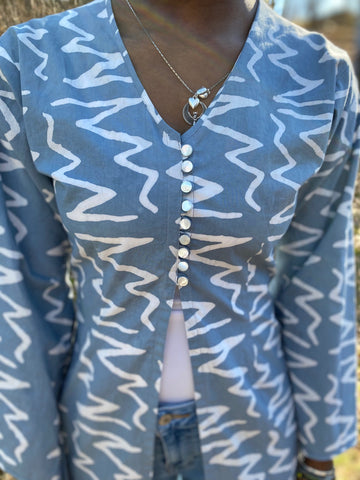


When we made the 124 Bolivian Milkmaid's Jacket in a PDF pattern last year, I fell love with it. The lines of this waist-length jacket are really great - and the statement sleeves are very fun! Add in embroidery options and this pattern is fabulously unique.
This traditional jacket, worn by working women in Bolivia, has its roots in colonization by Spanish from the 17th century. Hence the fitted, short-waisted look with large sleeves and tight cuffs. And, often this jacket was made of velvet and embroidered with chain stitching and beading. You can see the back of our original jacket below.

There are three versions of this jacket in the pattern, with slight differences at the waist. View A has a wide band at the waist, but View B continues below the waist (no waistband) and the last version expands the look at the waist to include a flared peplum made of small triangle godets. And, of course, you can make many variations with the pleats, embroidery, adding length, adding collars, etc.

I had a vision of making an unembroidered jacket with a waistband (View A) with a modern fabric. A jacket that would show the lines off of this pattern - that would showcase the sleeves, cuffs, and fit of the jacket.
I chose a light-colored denim from Fancy Tiger Crafts (Robert Kaufman 10oz denim). For the sleeves, I decided to make regular pleats (rather than box pleats) and sew down the pleats (an option given in the pattern). I tried the same idea for the pleats at the cuffs too, but I did not like the way it looked because the sleeve was so fitted quite a way up my arm. So I took out the stitching on the pleats and left them open. I liked that look much more.

I also left off the pockets because I did not think I would use them and I did not want to disrupt the simple-ness of the jacket. And, of course, they are optional. This was also an unlined jacket, so I wanted an simple inside as well. I let the hook and eye closure be very visible. I may change this later, but for now, I like it. A little hint about hook and eye closures is that if you alternate which side you put the hook and eyes, it is less likely to fall open or un-hook.
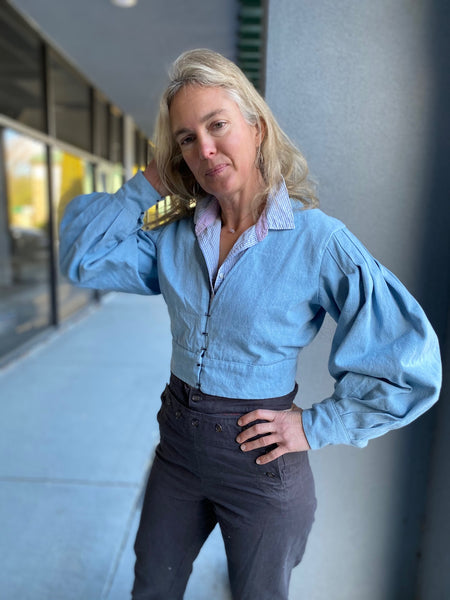


I really love this unique jacket - how it looks and what a great sewing project it was. I knew this jacket would look great with our 229 Sailor Pants. It would really look great with any high-waisted pants or skirts.


Now I want to make another one and add lots of embroidery! Stay tuned for some tutorials on the embroidery ideas from this pattern.
And, tell me! There are so many options from fabric choice to embroidery to design . . . what would you make with this pattern??

According to Elizabeth Ewing in her 1978 book, Dress and Undress: a history of women's underwear, the origins of the corset were rooted in Italy. But it was Catherine De Medici that first introduced it as an undergarment in France, in the 1500’s. Due to the intermarriages among Western European royal families the corset became an identifier of royal status. The corset’s appeal traveled throughout royal courts all over Europe, where the attending ladies of these courts were also quick to embrace this body altering apparatus. The idea that ladies could alter their figures to mimic that of royalty and therefore follow the latest in fashion trends was just too irresistible! This new trend would find its way to the masses and the corset would become the under-garment du jour. Unwittingly, this trajectory would literally alter the shape of women’s fashion for centuries to come. While the corset may not be worn on a daily basis as it once was, this undergarment continues to tantalize with its mystique and myths, some seven hundred years later.
The corset eventually became an essential piece of every European woman’s wardrobe, no matter the class or socio-economical divide and would endure throughout most of modern history. It would seem that every era in history would produce it’s own varying versions of the corset. Even regional folk dress was influenced by the corset - the Polish vest (found in our 126 Vests of Greece and Poland) is called a "gorset" (i.e. corset) in Poland.
When the Folkwear 267 M’ Lady’s Corset was designed, we sought to create the impression of a Renaissance garment, rather than a pure authentic re-creation.

M’Lady’s Corset is a representative of the late 16th- and early 17th-century under-garments. The Square-neck version would have been worn by upper-class women in the royal courts and working class women would have worn the Scoop-neck version. If you consider that one laces up the back and the other closes in the front, you can deduct who was being waited on by a ladies maid and who was dressing themselves.

Both versions feature a dropped waistline at the center front to give the V-shape that was characteristic of the Elizabethan era, and wide set shoulder straps to further emphasize the small-waisted impression. The Square-neck corset laces in the back with purchased eyelets or handmade eyelets, and adjustable straps that lace through eyelets in the front. The Scoop-neck corset fastens in the front with purchased hook-and-eye tape, and features a peplum that reflects the waistline tabs of the 16th-century doublets and corsets. You will find all you need to make your own eyelets and so much more in the instructions included in the pattern.
Our 267 M’ Ladies Corset while not purely authentic to the Elizabethan era, does take advantage of the form-fitting technique that princess-type seam construction easily allows. Princess seams were incorporated into the design of our corset because it is a successful and versatile method of achieving good fit. This type of seam construction is easy to adjust for individual fit and does not require major re-drafting of the pattern pieces.


While well-to-do ladies’ corsets would have provided figure shaping support through the use of stiffening materials such as boning and sturdy underling materials. Both pattern versions included in the M' Lady's Corset, gives you the option to add supportive materials or not. Depending on how serious you are about the construction of your corset… is up to you.
For the purpose of this blog (and lack of having a proper ladies maid), we are featuring the front entry, scooped-neck version. Which easily transforms into a romantic and comfortable top for warmer temperatures to come! This version of 267 M' Lady's Corset, may not have been what peasant women would have worn in their daily lives, but it is still charming none-the-less. And really makes a great modern-day top or sexy undergarment.


Sans boning
I made this particular corset for causal warm-weather wearing, so the boning and any stiffening materials were left out. Instead the princess seaming is relied upon to provide a corseted effect. Any fabric with a bit of body and that can easily be lined without creating bulk will work. Cotton, linen, silk, and summer weight wools would all work nicely for the main outer fabric. Handkerchief linen, cotton lawn, cotton voile, cotton batiste, cotton muslin, rayon, and silk habotai would all make good linings. I made this corset using a light-weight quilting cotton, combined with cotton seersucker for the outer fabric. And I used a finer-weight cotton shirting for the lining. The fabrics used for this blog literally came from my stash and cabbage scraps. Depending on the look you want, this pattern is a perfect candidate for mixing limited amounts of yardage.
Of course, you could make this pattern out of a single layer of fabric and wear more like a bodice blouse. Just be aware that finishing the seams and edges will need to be considered.
In addition to the easy to make construction of his pattern, it provides plenty of good coverage in all the right places for a flattering and comfortable fit. All of which makes it perfect for everyday-wear. Try this corset alone or paired with a light weight linen or cotton top underneath, layer it over a dress length chemise for a modern look with a nod to history. Pair it with a skirt, high-waisted shorts, or pants for a charming and fresh summertime feel. Even paired with your favorite jeans it makes for a great sassy look!
A bit about hook & eye tape
Hook & eye tape makes for a neat and clean closure when two fabric pieces meet, but do not overlap. When purchasing hook & eye tape, know that it comes in different types of fabric. Purchase your tape that most closely matches the fabric you are using if you can. Most tape are made of synthetic or cotton. Cotton is always nice because it can be dyed to match your fabric. Typically, hook & eye tape comes in white, black, and natural linen (for historical use).
Not all hook & eye tapes are created equal when it comes to the spacing of the hooks & eyes. The spacing generally ranges from 1 to 1-1/2 inch spacing. For better closure results, 3/4 inch to 1-1/4 inch spacing works better. You can always add extra hooks & eyes if necessary.
Note that some hook & eye tapes have an underlap or under-curtain, that over lap. While others tapes meet together. Depending on the look you prefer will depend on which tape to use. If hook & eye tape has an underlap, you can carefully trim it away if you like.
Of course you could always create a closure with loops and tiny buttons running down the front of the corset for extra added interest. If you wanted to add buttons with buttonholes, you can adjust the pattern to allow for the center front to overlap. Notice in the photos below, that the buttons are purely decorative. If you look closely you can see the hook & eye closure.


Tip: Hooks go on the wearer's right; eyes on the left.
Supply sources for all your corset making needs, including boning:
www.farthingalescorsetmakingsupplies.com
https://www.braandcorsetsupplies.com/
Find more sources included in the 267 M' Lady Corset pattern!
Whether you make a more historical version or transform this corset pattern into an everyday garment, the 267 M’ Lady’s Corset pattern is a versatile option for anyone who would like to give corset making a try. Be sure to get your paper or PDF pattern on sale during the month of February! The perfect Valentine's Day gift for yourself or for someone special!
The next time you are watching your favorite period piece film, or the modern fashion trends, pay attention to the corsets and remember the Folkwear’s 267 M’ Lady’s Corset pattern. As always, we look forward to seeing what you have been inspired to make!
I would like to thank Sarahbeth Larrimore for her allowing me to use her as my muse and model.


If necessity is the mother of all inventions… then figuring out how to stay warm is as good a catalyst as any. Our ancient ancestors created a simple yet highly effective technology that kept people warm, and enabled them to migrate to otherwise uninhabitable corners of the globe. Our ancestors figured out that sandwiching lofty natural fibers, such as wool or cotton, between two layers of cloth, then stitching the layers together, would create a highly insulating fabric known as quilting.
Generally, we associate quilting with the cozy bed coverings that our grandmothers made, but not necessarily with clothing. There is evidence that quilted fabric was actually worn in China and Europe as far back as we have been able to trace. Quilted petticoats and skirts, as it turns out, have played an important part in fashion history, providing much needed warmth along the way.
Folkwear's cozy and beautiful 206 Quilted Prairie Skirt is the link to the old ways of designing warm clothes while providing ways to make modern versions of this classic. We hope you will find inspiration in this blog to make a version that is all your own. Be sure to check out all the additional historical information and tips provided with the pattern.

You do not have to be a master quilter to enjoy making this skirt. The quilting can be done by hand or using a sewing machine, or a combination of both. Or use a pre-quilted fabric like the skirt featured and modeled above. Folkwear’s very own Molly made her skirt out of a jacquard fabric (pre-quilted look) with this fabric!
The design you choose can come from your own creativity, inspired by traditional quilting, or somewhere in-between. Use a fine fabric like silk or velvet, for a fancy evening out. Or make an everyday quilted skirt out of wool, cotton, flannel, denim, fleece, or linen for any activity made better when encased in your very own wearable quilt. The possibilities are only limited by your imagination.
Let's learn more about the history that inspired the 206 Quilted Skirt pattern and why this garment was so popular for so long! And, we hope you will make your own version and enjoy a truly personal statement piece that will add warmth to any wardrobe.

The history of quilted petticoats or skirts can be traced to at least 1644 in Europe. It is possible these garments were worn a early as 1530. This period saw the advent of an extremely important innovation in clothing. For the first time since the Minoan culture of Crete some three thousand years previous, long gowns with voluminous bell skirts, shaped by bulky petticoats became popular in Europe. This popular new skirt design was split from the waist to hem, displaying the lavish pleated petticoat underneath. This split created a long upside-down “V”, a mirror image of the “V” shaped neckline.
This Renaissance split-skirt fashion persisted until about 1630, when women were still exhibiting their magnificent undergowns by holding up their long skirts while walking. After 1670, skirts became even more full and reached to the ground, splitting again in the front to reveal richly worked petticoats underneath, which, according to the famous English diarist, Samuel Pepys, was often the most ornate and expensive item of the dress. Elaborate methods were used to hold back the overskirt to make the most of the precious petticoat; a particularly ornate procedure was to bunch up the overskirt like a bustle and fasten it in place with a ribbon attached to the shoulder of the bodice.

These petticoats were made of three layers; a bottom and top layer, with batting made of wool, cotton, or linen sandwiched in the middle, the layers were then stitched together resulting in a quilted effect. Petticoats were worn not only for layering warmth but to create a desired shape and structure to the skirts worn over them. Batting or wadding as it was also called, often did not extend up the entire length of the petticoat, leaving the waistband free of extra bulk. All kinds of extra padding were used during this era to enhance the natural body form, depending on the desired effect and style of the day. Quilted petticoats served through the addition of extra padding and a top layer that smoothed out and concealed any combination and variety of hoops, panniers, bum rolls, etc., hidden underneath.

Caraco jacket in printed cotton, 1770-1790, skirt in quilted silk satin, 1750-1790
During this time, fashion changed in incremental steps, which in this case, helped to ensure the petticoat to remain as popular as ever throughout Europe. However, it would be in eighteenth century England, that the quilted petticoat hit it’s peak in popularity. It seemed just about every lady was wearing one! This was in part due to the cold damp weather of the British isles and the availability of a broadening range of fabrics made possible by the expanding trade industry. These fabrics included cotton, linen, silk, and wool. Hence, the quilted petticoat would become synonymous with the Georgian Era. This popularity extended to France and America as well.
During the Georgian Era, a change occurred in fashion that brought petticoats out of hiding and to the visible foreground. Petticoats were now worn as the outer most layer, often with many separate crinoline layers made of cotton or linen underneath. This quilted petticoat design was typically tied at either side of the waistband, with gaps in the side seams that allowed for easy access to a pair of pockets worn underneath. Learn about the History of the Pocket here. This visible quilted petticoat was so popular that it translated to all segments of society, from nobility to laborers.
Well-to-do ladies wore their gowns open at the front, not unlike a stage curtain that revealed and showed off the highly prized, elaborately stitched, decorative statement piece underneath. This staging or framing showed off the petticoat typically in a contrasting or matching colored fabric made or silk or satin. Fabrics made of vivid and highly saturated colors in red, pink, blue, green, and yellow were highly fashionable. Shades of white, silver, and gold fabrics were very popular as well.


The hand stitching used could vary greatly to create patterns and designs that ranged from simple to elaborate. Geometric patterns such as stripes, and diamonds were common. More realistic motifs such as florals, animals, swirly flourishes, even scenes and landscapes were popular, as well. Usually the most elaborate and detailed stitching work was centered at the front of the petticoat where it was the most visible. The amount of details on the remainder of the skirt would vary depending on how much of the petticoat was visible due to the drape of the curtaining fabric used to set it off. The more elaborate stitches and quilting designs were very much an indication of wealth and status. Fine and elaborate petticoats could take months if not years to to make, therefore an extravagance only the wealthy could afford. Even among the rich a used petticoat was a welcomed and prized gift.
The outer most display of the petticoat may have been the focal point of the outfit and an indicator of the status of the wearer, however the underneath or backing was not an overlooked afterthought. Just because the underneath side of the petticoat or skirt was not seen, did not mean it was denied creative consideration.
Granted the underneath or backing material of petticoats was not as elaborate as the featured side, even for the wealthy. This was in part due to a modest nod towards economics and practicality for those with more than enough means. The underneath side was not seen, so cheaper fabrics like sturdy linen or calico cotton were used. The underneath sides of historical petticoats often demonstrate how more common fabrics were combined to express whimsy, sophisticated color and texture combinations, while providing a possible insight into the individuality of the maker or wearer -- no matter their economic status.
Because women had little opportunity to express themselves creatively as individuals and had very little true privacy, their clothing became an outlet of individual expression and control. Throughout history, we often find hidden elements left behind in women’s garments that reveal a secret peek into the personalities of the individual who wore them.
The wealthy women who wore these beautiful garments and the poorer women who made them, lived lives on polar ends of the social and economic spectrum. While some wealthy women crafted beautiful hand work and sometimes made their own petticoats, this was generally work relegated to the poor. It was not only the fine fabrics their gowns were made of, or the degree of detail and artistry in which they were stitched, that separated the classes. Petticoats had a way of revealing the story of the haves and have nots.
 A romanticized depiction of field work.
Makers of these fine garments were paid a pittance for their talents and labor. It was not a lucrative way to earn a living by any means. It took copious amounts of time to create such works of art and the rewards were barely enough to survive on. The poor women who created such stunning beauty for others to show off, were not only denied a fair wage for their efforts, but denied the ability to indulge themselves in their own talents.
Poor women made many fewer and simpler versions of petticoats for themselves and their families. These petticoats were made of everyday durable fabrics, like calico cotton, wool, and rough hewn linen. Their petticoats were much more practical to fit their lifestyles. Figure shaping under paddings encumbered and restricted the movement of women who worked and labored. The extra expense of such unnecessary items were not a priority to the poor. Therefore, petticoats were worn more simply and plainly, due to the need for practicality and warmth. Aprons generally tied or looped at the waist, replaced the fancier framing fabric counterparts of wealthy women's outfits.


Poor women may have not been able to afford the fabrics they would have chosen, but that did not keep them from paying attention to the aesthetic of the days fashions. Just like their wealthy counterparts, poor women were interested in fashion and took pride in displaying their knowledge of current fashions the best they could. They used the best fabrics they could acquire for the outer layer of their petticoats and they economized for the underneath layer, often creating charming and sophisticated displays of artistic talent. Often these petticoats were made of a miss-match of what ever fabric they had on hand or could be traded with other women. This did not mean these women lacked in displaying a sophisticated design sense. Besides needing fabric that could withstand the rigors of physical labor, they simply did not have the luxury of extra hours to spend on their own clothes. Their stitching was much simpler and less of it, because of the time required to do more. Simply stitched channels were often the extent of any quilted details. Despite having to make do with what they had or could afford, these women still managed to make petticoats worthy of admiration.
Even though quilted petticoats were hugely popular among almost all women of the period there was a harsh distinction none-the-less. Women of polarizing economics may have been bound by a desire to partake in fashion on whatever level they could afford. However, their common bond may have only been a shared warmth provided by their quilted petticoats, but little else.
Eventually this practical fashion made it's way to the "new" world, where women on the cold prairies wore these skirts - and where Folkwear got the inspiration and samples for our pattern.
Clothing has always held more meaning for women that just protecting one’s body from the elements. Even when women have been denied beauty due to their economies, they have found ways to create their own. I hope you find inspiration in making something beautiful for yourself or someone else and continue to forge the bond that unites those who appreciate what it takes to make something from nothing.
The Folkwear 206 Quilted Prairie Skirt Pattern is the perfect canvas in which to celebrate your own creativity and at the same time recapture a bit the spirits of our ancestors. As always we look forward to seeing what you have been inspired to create!


This month Folkwear is featuring the 111 Nepali Blouse Pattern, which is a beautiful piece, often worn by Nepali women as an over blouse. While this blouse is considered a traditional garment, typically made of velvet, it has a truly contemporary feel, which makes it a perfect complement to any wardrobe.
This versatile pattern can be made for any season or occasion. For everyday wear it would be lovely made of fabrics such as cotton, linen, rayon, light wools, or even knits. Any fabric with a bit of drape and a light to medium weight would be suitable. When made in velvet or silk it is transformed into an elegant and comfortable garment whether for a special occasion or for blissfully lounging about. Shorten the sleeves for warmer temps and enjoy year round. The blouse can be worn open at the collar (simply omit the top sets of ties and cut just four ties for the waist). The ties could also be made of ribbon or even be replaced with buttons, hooks, frogs, or snaps.

Since the Nepali Blouse is traditionally made of velvet, this is a perfect opportunity to learn more about velvet and how to handle it. Velvet can be a tricky fabric to sew with, but the tips below will make it much easier and less intimidating to work with.
Most velvets available today are made of rayon or silk. They generally have a very drapey effect and sometimes a bit of stretch, that work well for tops, blouse, skirts, dresses, pants, and scarfs. The photos below shows the soft silky drape of silk rayon velvet. This type of velvet has a distinct nap, which captures the light creating a beautiful shimmer.


Velvet can also be made of cotton and polyester blends, which generally have a more stiff hand or feel, and are perfect for more structured pieces, like coats and jackets. The velvets in the photos below are made of cotton and have a stiffer drape and the sheen is typically more subdued than silk and rayon velvets.

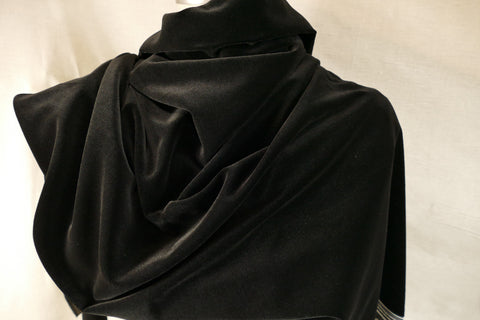
While silk and rayon velvets are stunning and rich fabrics, they are not the easiest fabrics to control and require a bit of extra attention. This blog will help provide some tips to ensure successful sewing for any velvet sewing project on your list. Use these tips for making the 111 Nepali Blouse, as well as the 120 Navajo Blouse and the 124 Bolivian Milkmaid Jacket, which are also traditionally made in velvet.
Also view or download these tips as a PDF.

PRESSING TIPS
Because of the different nature of velvet fabric, it is a good idea to practice and experiment on a few scraps before you make your final project. Here are a few experiments to try using velvet.
While working with velvet takes more time and effort, the benefits are well worth it. No other fabric compares with the unique quality of a stunning velvet. Use these tips to make a 111 Nepali Blouse and for all your other velvet sewing projects.
View or download this as a PDF.