
-
Sewing Patterns
-
Fabric
- Sewing Supplies
- About
- Blog
- Gallery
-

When we decided to bring back the Calico Day Dress from the Folkwear archives, I had my doubts. We had many customers over the years contact us to ask us to bring it back, but I saw the dress as a bit dowdy, maybe only for costume, and I was also concerned that it used so much fabric (making it expensive to make). However, once we started working on the pattern, my mind changed.
When we started the work to bring it back into print, we decided first to grade the pattern up to 2XL. The original only went to our current size Medium (which is pretty tiny). And, then we improved the instructions, clarifying certain areas and making sure it came together easily. It really is a pretty easy dress to sew! Even with the ruffles, the flounce, and the inside bodice lining, it takes less time and effort than I thought to make this dress.
I made the brown Calico Day Dress sample below with a calico cotton print I found at Joann's. I made the inside bodice lining with a cream colored print, which I though made an interesting contrast to the brown. I enjoyed making the dress below a lot and it got me thinking of the ways to make a more modern, everyday type dress I might want to wear.

Then I came across an ad for Boden, and the dress they showed in the ad looked so much like the Calico Day Dress! I had been thinking about a dress that would be warm to wear in winter -- long and with long sleeves. So I decided to make one for myself based on the look of the Boden dress I'd seen.
First, I wanted fabric that would be flowing -- not a cotton, but something with silk or Tencel. We had a couple of lovely Tencel twills in stock (red and green) and I decided to use the brick red colored Tencel. The twill gives the dress just enough weight to make it a wonderful winter dress -- it has some heft and is flowing (and does not wrinkle easily).
I cut a size Small for this dress. I am just about between a size Small and Medium for Folkwear grade rule, but the medium can sometimes be too big for me. If the garment is not very fitted, then a Small is usually perfect. That was the case for this dress. There is actually lots of room at the bust, waist, and hip. The most fitted area is the lined bodice at the waist (but I left that part of the dress off).
For my dress, I did not want the bodice lining because I wanted the front to button up (not the lining) and I wanted less bulk inside. I also did not want the yoke shoulder ruffles so I left those off as they seemed too vintage/historic and I was wanting a modern look. Finally, I wanted just a collar stand and not the full turndown collar. So I only cut the collar stand piece and not the collar. I wanted the belt to be longer so that I could tie it, so I added about 9" to the middle of the belt. If I did it again, I would add more length (and I could always easily remove this belt and make a new one). Finally, my fabric was nearly 60" (150cm) wide, and I was trying to save fabric, so I only cut 2 flounce pieces rather than 3 and I used the whole width of the fabric for the flounce (rather than the pattern piece length). This still gave me lots of flounce and room to gather. And possibly, 3 flounces would have been too much, especially for the size small.

So, because of all the pieces I did not use (bodice lining, ruffle, collar, and extra flounce), I was able to cut out this maxi dress from just 3.5 yards of fabric! That felt pretty impressive to me. Though I was definitely doing some pattern tetris to get all the pieces to fit!
AND, I added pockets to the dress. I had enough fabric from the left over scraps to cut 4 pocket pieces to add to the side seams. We have a whole tutorial on adding pockets to side seams, so you can get a free pocket pattern and read all about it here.

Construction-wise, this was pretty simple, especially without the extra pieces. It is pretty easy to leave off the bodice lining; nothing depends on the lining for further construction. I sewed the the collar stand as I would have a collar (sewed all sides but the one to attach to the neckline) and attached it as normal. It all came together pretty easily. Gathering the flounce is always a bit of work, but marking centers of the flounce and dress front and back is a huge help. I sewed the center front seam all the way up to my waist (which was much higher than the box in the pattern) because I wanted to have buttons just go from my waist up. I only added 3 small buttons to the front seam/hem so that it buttons up the front. Again, there was enough ease in this pattern that I can easily slip it over my head to get it on and off. If you want it to be easier to get in and out of, keeping the front seam attached from the square in the pattern to the hem is a better idea. But, this works perfect for me.

I really like how this dress turned out! I can wear it to work or church. I can wear it with tights or leggings underneath for more warmth, with a scarf, with a jean jacket. It feels quite versatile. I also have some thoughts about adding embroidery down the center front seam and/or the collar stand.
What do you think? Does the Calico Day Dress work as a modern dress? How would you make this pattern up?


By Esi Hutchinson
In a previous blog post, Molly makes a good point that some of the Folkwear Patterns don't have pockets due to the traditional and historic nature of the garments (based on how the fabric was woven and the culture they come from), but that doesn't mean you can't add them. Read the blog post here about adding a patch pocket to your pants. I would also encourage you to read this blog post about the history of pockets and the hierarchical roles they have played in clothing.
In today's short blog post, I will show you how to add a side seam pocket to 119 Saroulles. It is very easy! The pattern pieces make it very simple to add a side seam pocket. You will need a pocket pattern piece, plus the 119 Sarouelles pattern. You can download and print a free pocket pattern piece here, and you can read more about side seam pockets in this blog post. The fabric yardage won't change if you include a side seam pocket for this pattern.
The African and Turkish pants in this pattern are cut with the side of the pants on the fold. So there is not normally a side seam. However, to add a side seam you just need to add 1/2" (13mm) seam allowance on the fold line for your size. I'm making a large, and the green line in the image below is the original fold line and the pink line is my new cutting line.


You can add notches to the new side seam if you like. I included double notches about 18" down from the waistline so it would make it easy to line up my side seams.

With the side seam, you will now be cutting four pants legs instead of cutting two on the fold.

I wanted my pocket bags to be larger than the free downloadable pockets we have (linked above) so added some extra room. This is an easy pattern drafting step anyone can do.

Usually pockets are placed 2" to 4" (5-10cm) below the waist. I marked 2" (5cm) below the waist for the top of my pocket placement.

Sew one pocket piece to the side seam of each of the four pant pieces, from the top of the pocket to the bottom of the pocket, and press the seam toward the pocket. I placed dots 1/2" (13mm) above and below the bottom and top of the pocket. I added the dots to indicate where to start and stop sewing on the outer seam of the pocket when I sew the pants legs together. You can also understitch the pocket so the pocket doesn't roll out -- stitching the seam of the pocket/pants to the pocket.

Sew the two pants pieces together starting from the waist down to the dot of the pocket, around the outer edge of the pocket up to the lower dot and down the rest of the pant leg.


Now you can continue with the pattern instructions to finish your pants. This pocket tutorial was made with my muslin to make sure I cut the size I wanted. I made my final pair out of a Lyocell Twill in the color Balsam.


Below are the African Pants from 119 Saroulles. I picked this fabric for a casual dress pant look. I think these pants are super comfortable and with the right fabric the pants could work for different occasions.


This post continues our series of blog posts on pockets by showing you how to add a patch pocket to garments. More pocket posts are below!
Some Folkwear patterns do not have pockets due to the historic or traditional nature of the garment (read more about the controversial history of the pocket here). But, we want to help you be able to add pockets whenever you wish!
The patch pocket is a useful and easy pocket to add to any garment. It can change the look of the garment because, unlike the in-seam pocket, it is very obvious and in plain site. It can easily become a design feature of your garment if you want to make it in a contrasting color or pattern. You can also choose to make the patch pocket in the same fabric as the garment, matching patterns to keep it as unobtrusive as possible.
You can make patch pockets in many different shapes, but I am going to show a fairly simple rectangular pocket with a diagonal opening. You can find the (free) pattern for this patch pocket here. This pattern can be printed on one sheet of 8.5"x11" paper or A4 paper.

You can change the design or look of this pocket fairly easily by extending or widening the pocket, rounding the corners, making the straight opening into a curve, or adding bevels to the corners. You can use your imagination and think about what shape you like best for your garment. Here you can see a couple of options for different looks of this pocket.


Patch pocket designs: beveled corners, rounded corners, curved opening
I made this patch pocket large enough to fit my phone (since I am usually hauling it around with me), and I made it to add to my favorite pair of Sarouelles. The 119 Sarouelles pattern is perfect for a patch pocket. There are no side seams to add a pocket into the seam on this pattern, so the only other option is to cut in a welt. Which I did not want to do. The patch pocket is so much more simple, and this fabric will be perfect for a patch, seeing as it is already made from pieced together cloth strips. And, I had some extra fabric leftover after making the pants.

To make patch pockets
First cut out the pattern and use it to cut the pockets from your fabric. You can use the PDF pattern we provide, or the measurements I have here in the photo (6" wide by 4.5" tall on one side and 8.25" tall on the other, and 2.5" wide at the top - add 1/2" seam allowance all around and/or 1" at the opening). This pattern does not take much fabric. You will need about 1/4 yard (or less) for two pockets.

If you want two pockets (which is the norm), be sure to cut so you are getting two opposite pockets (i.e. fold the fabric wrong sides together and cut two).

First, finish seams on all edges except the opening edge. You may want to stay stitch the opening edge so that it does not distort while you are stitching (and folding and pressing).
Then, you can turn under the opening edge twice and stitch. Or, you can finish (or serge) the opening edge and turn down once and stitch. I serged my edges, and turned down the opening edge twice. Then, press under all outer edges of the pocket by 1/2" (13mm).

Now place your pocket on your garment where you want it to be sewn. I marked where I wanted my pockets with tailors chalk and pinned the pocket to the pants.


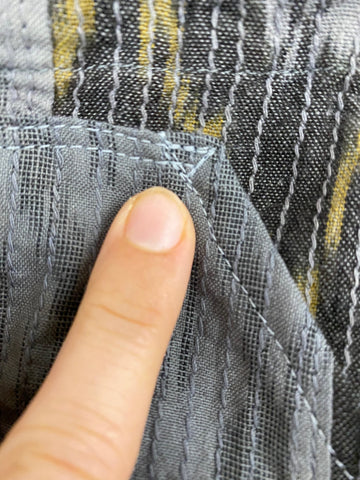
Sew pocket to pants by topstitching close to the folded edges along all edges except the opening edge. I also like to add a bar tack or to sew a small square or triangle at each opening edge to reinforce the opening (I hate it when my pockets rip). You can also add another row of topstitching about 1/8" (3mm) from the first row of stitching to help reinforce the pocket. I like to increase my stitch length a bit for topstitching - to 3 or 4. And, to manage corners, keep the needle down and pivot fabric at each corner. You may need to adjust with the flywheel when nearing the corners so that you don't over- or under-shoot the corner (i.e. go too far or not far enough to make a neat corner).

These patch pockets are perfect! I love that these pants now have pockets, making them much easier more convenient to wear. They look great with lots of tops (this one is actually a dress that I made from silk noil from Stone Mountain and Daughters Fabric).
So I hope you will be able to now easily add patch pockets to your clothes, even after they have been finished!


Watch the video on patch pockets for the 119 Sarouelles below:

by Molly Hamilton
When I was growing up, my paternal grandmother had a shop in Banner Elk, NC called The Gaelic Shop. She sold imported goods from Scotland and Ireland, many of which she sourced from her trips to those countries. She would find crafts people working from their cottages and set up a relationship for supplying her shop. She carried hand knit wool sweaters, scarves, belts, sporrans, leather goods, tea towels, and many other things from classy-but-touristy knick-knacks to estate jewelry. And she also carried kilts, in many of the clan tartans. Her shop smelled like wool, leather, and lavender and I loved it.
We also participated in the Grandfather Mountain Highland Games for many years when I was a child. My grandfather had some kind of leadership position in the Armstrong clan for a few years and we would spend all day, every day of the Games on the mountain. I cherished those times -- an amazing picnic that my grandmother would pack, bagpipes and fiddles playing, dancers to watch, all the games, and the vendors with their beautiful things to buy. And all on top of a beautiful mountain meadow with the summer sun and breeze and everyone having a good time.
When we at Folkwear decided to feature the 152 Scottish Kilts pattern this month, I also decided we needed to make a kilt for our sample collection. We have a (women's) kilt skirt and a child's kilt, but no man's kilt. And I've been wanting to get photos of a kilt for the website too. The woman's kilt pattern is included in the 152 Scottish Kilts (called a kilt skirt), and a child's kilt pattern can be found with our 154 Child's Scottish Kilt and Jacket pattern
And, I wanted to make a kilt from our pattern. Our instructions for making a kilt are slightly intimidating when you read through it -- very detailed and with a lot of steps. They were developed for Folkwear by Ann Stewart, a world-renowned kilt maker (her daughter still makes kilts in her shop). These instructions are detailed and authentic for making a tailored, traditional Scottish kilt. And they do not use any pattern pieces. The kilt is made from a length of tartan. No pattern pieces are needed -- just some good measurements, rulers, thread, and needles. And a bit of time and patience. Once I started the kilt, I found that it went fairly easily if I took it step-by-step.
In this post I am going to go over a few things about making the kilt. I am not going to show you how to make the kilt (that's what the pattern is for - and it is too involved for me to do at this point), but I am going to give a few helpful tips and tricks that I hope will help you navigate this pattern easily and successfully.
Most of the kilt is hand sewn. So keep that in mind when starting on this pattern.
First though, this was also my first attempt at making a kilt. So, if you see something that looks wrong (or is wrong), please forgive (and kindly let us know if the comments). I am not a master tailor and I skipped a few steps (I'll let you know about that below). This may be sacrilege to some, but mostly I want to help make this kilt pattern accessible to everyone. So, don't be intimidated, but also don't be too critical!
Measuring
First of all, I did not have great measurements for this kilt. The measurements I was given turned out to be too big for the person I was making it for (I am not sure what happened!), but the kilt fit the measurements I was given! So just bear with the not super great fit on our model (I need to find a larger man!). But the instructions made the right size for the measurements, so that was good! However, a big tip will be to get good measurements and test the kilt out on the person it is for (if you can) before sewing the pleats at the hip-to-waist (Step 3). You can always adjust pretty easily at that point by adding a pleat to either or both sides (adjusting the over- and under-apron size and darts) and/or adjusting the pleats at the waist to get to the size you need.
Measuring, and measuring accurately, is critical for making a kilt. Waist and hip measurements, length measurements, difference between waist and hip, distance between waist and hip -- all these are important measurements. And I found it helpful to have a sheet of paper with all these numbers on it and space below where I could do some of the basic calculations that are needed for making the kilt. So, I made a simple sheet you can print out and use when you are making a kilt to help you keep track of these numbers and refer back to when kilt-making. Download and print the free PDF here.
Planning Your Kilt
For this kilt, I used a piece of wool tartan that I found in my fabric stash. It was one my maternal grandmother had bought many years ago, and from the label is a Douglas clan tartan. Her family may have had a connection to the Douglas clan, but I also think she really loved the name Douglas and liked the tartan. Anyway, you can search official tartans on the Scottish Register of Tartans to find your family's tartan. Finding tartan fabric is not easy. You likely won't find it at the local fabric store or even your regular online fabric shop. I will list some suppliers of tartan fabric at the bottom, but you can also find these fabrics at any of the Scottish Games or Festivals that happen in various places.
The pattern (and a kilt, in general) calls for 8 yards of single width fabric (30-32" wide) or 4 yards of double width (60" wide) fabric. Again, this might be sacrilege, but I only had just over 3 yards of double width fabric, and I was making a kilt for a large man, and it worked fine. You may not get quite as many pleats (though it seemed good to me), but you can work with shorter lengths than suggested and still get good results.
I cut the long folded edge of the fabric off when I cut the fabric down to the length I needed. Later I used this folded edge piece to make the waistband, belt pieces, and belt loops. I laid out my two pieces on the ground (where I had the most room) and labeled each side with chalk to mark the right-side-up and which side was to be the under-apron and over-apron. This was a huge help and I think very important.

I also used chalk for all my markings on the kilt. Chalk was a great option - works well on wool, can be brushed off (erased), and can be pressed without issues. I did have to re-mark the kilt if I took too many days away from the project or moved it around (which I did often because we moved offices when I was making this kilt).

Pleats and Darts
The pleating and darting was a little tricky, but again, I just started with one step at a time in the instructions. The waist and hip measurements were very similar for the kilt I made, so I made very tiny darts at the apron waists.


I ended up doing dress pleating on this kilt, which meant I kept the tartan pattern with the pleats (you can see the tartan pattern even though the fabric is pleated). I did not use the waistband/cut off piece to test or plan it. I just started folding the tartan to see what I thought looked good and it worked very well. One of the little "tricks" I felt I learned is that the pleats don't have to be exactly the same size all the way through. As long as they are about the same size, and they match up to get the look you want, it is fine.
My pleats were supposed to be .74" wide according to my calculations. I had an even number of setts between the aprons so I took my number and subtracted 7 (36 setts - 7 = 29 pleats). Then I took half of the hip measurement (for me was 21.5") and divided this by the number of pleats (29) -- so 21.5" / 29 pleats = .74". So I went with approximately 3/4" wide pleats, but sometimes they would be narrower or wider by almost 1/4". But it was not noticeable because of how the plaid pattern showed.
I had 2 sections of fabric to work the pleats on and I just put them together as if they were one, pinning them at the center back. I worked the pleats so that this seam would fall in the back of one of the pleats and would lay flat. This was easy to do because I also had several inches of fabric to work with since I was only considreing full setts as part of the pleat plan -- and there were not full setts left at each end of the fabric in the center back.
I will also note that my fabric had a few moth holes in it, but I was able to manipulate the pleats so that they were completely hidden in the garment. Just a little extra bonus to making this kilt!
I also hand basted all the pleats in place instead of using pins as the illustrations show. I think this was really helpful and if I needed to access inside the pleats, I could just snip the basting threads away.


Again there was a very small difference between the hip and waist for the kilt I was trying to make, so I did not have to take in much at the waist on the pleats. But, my feeling was that I would just adjust each pleat at the waist by about the same amount to take out the extra width to get down to the waist measurement. This is a good place to measure your kilt to see if it is coming out the size you expect. Mine was a little larger than the measurements I had, so I took in a little more at the waist than my calculations indicated I should, but that way it finished at the correct waist measurement I was using.


Buttonhole (and finishing pleats)
I did not cut the excess fabric from each pleat in Step Four of the kilt. By the time I got to this step, I was running out of time (and maybe patience?). So I only cut out the extra fabric in the pleats past the buttonhole so I could open the buttonhole pleat up. It wasn't totally clear to me that the pleat where the buttonhole goes has to be cut open. The extra fabric is not cut away, but the pleat does have to be cut open to access the stitching that needs to be opened up to make the buttonhole. And the pleats to the inside of this pleat were in the way of opening up for the buttonhole. So I cut the extra fabric away. But that was all I did. I am sure by leaving all that fabric, I was leaving in quite a bit of bulk, but I just didn't feel like it was worth it for this project.


Interfacing and Lining
I used a medium-weight linen for the interfacing and a light weight white muslin for the lining in this part of the pattern. These fabrics worked well and they were scraps that I had on hand. I thought they did a great job, but I don't know if they are considered totally appropriate for the application they were used for. They worked for me, but perhaps you would want to try something else.
I also trimmed my belt loops down before I turned them right side out (which made them much easier to turn out).

Waistband and Buckles
It was very hard to find buckles for the kilt. There are a number of Scottish wear and kilt shops but very very few that have the kilt-making supplies. I ordered them from Highland Xpress, but also saw them on Amazon (coming from Scotland). Highland Xpress had exactly what I needed for this kilt. I made my own buckle tab as instructed in the pattern, but didn't have it made (because the buckles had not yet arrived) when I took the photos of the kilt.
For the waistband, I used the fabric I had left from first cutting the tartan for the kilt. I could have tried to line up the band so that the vertical lines of the tartan matched, at least for the over-apron. They won't match elsewhere on the kilt because of the pleating at the waist and probably won't match on the under-apron either. And that is because the pleats at the waist are manipulated to fit the waist and so take in some of the extra fabric.
Also this is a good place to note that wool has some stretch to it. You can manipulate it a bit when fitting the waistband (and lining) to get it to where you want it to be.

Back of the almost finished kilt
Finishing
I also did not do the finishing technique that has the hem edge at the double sett pleat and corner of under-apron hemmed.
But I did do a LOT of pressing. I pressed the pleats consistently throughout the kilt making process once I had them basted. I pressed with steam from the front and back. I did not place them under books or other heavy items, but that is not a bad idea and could help keep the pleats super sharp.
Finally . . .
I really did enjoy parts of making this kilt. I liked designing the pleats and getting the kilt finished. I loved working with the fabric -- wool is so nice to work with. And I do like hand sewing and this was nearly all hand sewn. It took quite a while to finish this kilt, but I am proud of it. It is certainly not perfect, but it would look beautiful at the Highland Games on a summer day!


18 September 2024
Moving
First, if you haven't heard, we moved Folkwear to a new location! It is only about 10 miles from where we were located, but has nearly twice as much space and is right beside Western Carolina Sew Co. (and just down the road from non-profit Local Cloth). We feel very lucky to have such good neighbors! I borrowed a needle the other day from the folks at WCSC because I couldn't find my hand sewing needles (lost in the move and showed up today!) -- it is a great fit and so nice to have a related business to work beside.
We are now located nearly downtown Asheville, in the River Arts District, at 240 Clingman Ave Ext. You can come visit us when we are open, which is generally 9 to 4 Monday through Friday. And Western Carolina Sew Co operates a gorgeous boutique of their clothes (sewn right here in the factory) called Rite of Passage Clothing. The boutique is open Thursday-Sunday 11-5. To get to our studio, either ring the doorbell at 240 Clingman Ave Ext. Or, come to the back - behind Ultra Coffee and we are the first door on the wooden walkway.
It has taken some thought to get our space organized and moving all these boxes was a LOT of work! But we are so excited to be here. Personally, I am enjoying walking around the city during breaks and getting good coffee. I am hoping to bring my bike into the office soon and take breaks on the river trail which is near our office.


Printing and Folding Patterns
One of the reasons we needed to move to a larger space was because we bought a printer and folding machine to be able to print and fold our own patterns. If you have been following Folkwear's journey over the last 3 years or so, we have had quite a few changes in pattern printing options (read more about it here). And it has led to some hard decisions and some easy ones. Another wonderful company printed many of our slower-selling patterns over the last few years, but they are located on the west coast of the country so shipping was very expensive (lots of patterns are very heavy). They also could not always keep up with our demand and sometimes we would be back ordered on a pattern for many months. We decided to take control over part of our production and get a wide format printer that could use lighter weight paper, and print our own patterns.
The folding machine was harder to find but we tracked a Germany company down that makes and sells them and now we have a printer and folder. We are still figuring out the folding machine (there are so many folding options), but it certainly is nice to have to quickly and easily fold patterns.


We are now printing many of our patterns on 18# paper (as many very old Folkwear patterns used to be printed). This is a nice weight -- lighter than copy paper, but still very durable. Printing and folding in-house cuts our cost a bit, but mainly gives us control of our process.
We are still printing most of our best selling patterns at the Simplicity factory near Chicago. This saves tremendously on printing costs because they are able to print in much larger volume and on tissue (very lightweight paper). So we are still working on keeping our costs as low as possible so we can pass that on to our customers.
So all that means we do have a variety of different tissues for our patterns -- some are real pattern tissue (brown and very lightweight), some are still around from our McCalls printing days (white 8# tissue, not as lightweight as the brown), and some are on 16-18# paper (lightweight bond, but not tissue). I don't love that we don't have a consistent pattern paper, but it does save (you and Folkwear) a lot of money on printing and it allows many patterns to be able to stay in print rather than just be available as a PDF pattern.
The new printer and folding machine also means that we can print patterns for other people. We are working through the process, but for now anyone can upload their PDF patterns to our site, we will print them, fold them, and ship them. We are offering 25% off of all printed PDF patterns if you order more than one.
The Green Pepper
The other really big news, and bigger reason we needed a larger space, is that Folkwear LLC has acquired The Green Pepper, a sewing pattern company that provides patterns, fabric, and notions for outdoor clothes and gear. The Green Pepper has been around for over 50 years and has over 100 patterns in print for an array of clothes and gear for adults and children (and pets).

Late in the spring, Susan Downs, former owner of The Green Pepper, called me out of the blue and said she was interested in retiring and was seeing if anyone had an interest in taking over her company. She knew Folkwear nearly from its beginning; it was also a small indie pattern company founded on the west coast. And she had followed my journey with Folkwear when I took over nearly 7 years ago. I had heard of the The Green Pepper and knew it to have great patterns for outdoor wear. After talking with Susan for a while, I got really excited about the possibility. Susan (and she and her mother, before) had built a sweet little business with some really great patterns, also offering performance fabrics and notions. The integrity and kindness showed through.
After several months of working through all the details, we finally closed at the end of August. I flew out to Oregon to see what I'd bought and was delighted to meet Susan in person. The Green Pepper inventory is now on its way to Asheville, NC and our new location. Meanwhile, Susan is keeping things running smoothly while we set up inventory here, prepare for shipping, and get our new website online.
I am very excited to have The Green Pepper under the Folkwear LLC umbrella. It will keep its name, website, branding, and incredible patterns and drawings. We are just going to be ushering it into the future by updating the website, gradually adding PDF patterns, and potentially increasing sizing in some of the smaller ranged patterns. We mainly want to keep offering these great patterns and provide exemplary customer service to all the loyal Green Pepper fans.
You can read the press release for this exciting news here.
Finally . . .
All of these changes have come together fairly quickly over the last month. It has been a whirlwind. A bit wild, and a bit stressful, but very exciting. And no big changes would be complete without my children bringing home another pet. We got the opportunity to take a dog back into our house that we fostered for a short time about 9 months ago when my daughter brought him home from a farm. So now we have a large Pyrenees/Golden mix 10 month old puppy at home as well. He's bringing lots of joy to the family and just the right amount of chaos (and so much dog hair). And he does make me laugh with some of his antics.


By Esi Hutchinson
Welcome to Part 2 of how I made 250 Hollywood Pants Knickers into pants. To see how I made the adjustments for this design in my pattern pieces (and how I made the pocket larger), check out Part 1 of this tutorial. In this blog I am going to show you how I made the front fly with a zipper instead of a buttoned fly. While I do like the look of buttons on the fly for a pair of pants, I get frustrated when taking them on and off. So I decided to put in a zipper instead.
The pieces I cut out are below. I used the pattern pieces I made in Part 1 to cut out the fabric (an 8oz sanded twill). I didn't need the Cuff Placket J and Pocket Facing E, but I forgot and cut them out anyway. Whoops!

When sewing these pants I followed the instructions quite closely for the general assembly of the Knickers.
Starting with the right sides together and I stitched from the box to the top of the crotch seam.

I pinned the Back crotch seam and stitched and pressed the seams open and serged the seams.

Assembling the fly front is a little tricky. I highly recommend labeling your fly pieces (left, right) and right and wrong sides. Refer to this blog post where I walked through assembling and sewing the buttoned fly front of these pants if you need help figuring out the fly for this garment. However, if you are adding a zipper instead follow below to see how I did it.
Zippered Fly
Stitch the Right Facing C to the Right Fly C with right sides together on the unnotched edge and around the bottom to the box. I think it is helpful to clip in the seam allowance to the box before trimming. Trim the seam and turn the fly right side out.

Press under 1/2" (13mm) on the long double notched edge of Fly Facing C. Then stitch Fly C to Front Pant A, with right sides together, from the top to the box. Trim the seam.

Press the fly and facing away from the pants. Pin the pressed under edge over the previously stitched seam line to the inside of the right pant and topstitch.
Now work on the left side of the Pants.
With right sides together stitch the unnotched edge of Left Fly D to the double notched edge of Left Front Pant A from waist to the box. Press Fly D away from the Left Front Pant A.

Now we are ready to sew in the zipper.
The top of the zipper teeth needs to be 2-1/4" (5.7cm) below the top of both the Fly/Facing C and D to accommodate the Waistband Facings H and I in later steps.
Place the left part of the zipper with the right side face down onto the right side of the Left Fly D, making sure the top of the zipper is teeth is 2-1/4" (5.7cm) below the top of the Left Fly D and the center of the zipper teeth is 5/8" (1.6cm) away from the Fly D and Pant A seam.
Sew the left side of the zipper onto Fly D using a zipper foot, then stitch again close to the edge of the zipper tape. Try and stitch as far down as you can within the 1/2" (13mm) seam allowance.


Right sides together, stitch the Left Fly Facing D to the Left Fly D along the notched edge, backstitching at the box. I made sure to keep the extended part of the zipper that doesn't have zipper teeth on it out of the way of the stitching, but you do not have to do that. Trim the seams and turn right side out.

Trim 1/2" (13mm) off of the unnotched edge of Left Fly D. Press the Fly to the inside of the Pants along the seam line of the Fly and Pant seam.


Topstitch the pressed Left Fly/Facing D down through all layers including the Left Front Pant A.

Now back to the Right side of the zipper.
You should have already pinned the pressed under edge of Right Fly Facing C over the seam line of Fly C to the right Front pant A and topstitched.
Place the wrong side of the other side of the zipper on top of the Fly Facing C making sure the top of the zipper is teeth is 2-1/4" (5.7cm) below the top of the Right Fly Facing C and the center of the zipper teeth is 5/8" (1.6cm) away from the seam of Facing C/Right Pant A (the same way it was done for the left side).
Sew the Right side of the zipper using a zipper foot, then stitch again close to the edge of the zipper tape, stitch as far down as you can.

Instead of overlapping the Fly and topstitching the triangle as show on the pattern piece Fly C, I overlapped the Fly and stitched through all layers. Starting from the bottom of the fly, I stitched up 3/4" (2cm) backstitcing at start and finish and bartacked (small zig-zag stitches) through all layers.

Sewing the zipper is now finished, let's move on to making the rest of the pants.
Finishing Sewing the Pants
Stitch the Front A and Back B at the inseam, matching notches. I pressed the seam to the front and finished the raw edges with a serger.

I topstitched my inseam close to the seamline then topstitched again about 1/4" (6mm) away from the pervious topstitch. This creates a faux flat-felled seam.

Pockets
I don't need to use the pocket facings because I'm using the same fabric for the pockets as for the rest of the pants, and my fabric is midweight so I'm not worried about it being too bulky.
Right sides together, stitch one pocket side to the Pant Front matching stars and notches.

Clipping to the stars.

I serged the side seams on both Front and Back Pant pieces after I'd sewn the pocket sides to the Front and Back Pants.

Understitch the pocket side seams to prevent the pocket rolling out from the Pants. This keeps the pocket bag in place.

With right sides together, stitch the Front and Back together at side seams. Start with backstitching at upper star of the Pocket and stitch to the top of Pants. Then stitch from the fold at the bottom of Pocket to the bottom star of the Pocket and then down the rest of the side seam of the Pants.

Sew the top of the pocket closed

Waistband and Belt Loops
Make the belt loops and sew the waist facings H and I as instructed.
Pinning the waist facings to the inside of the Pants.

Sew the bottom of the belt loops in place. Then make your buttonhole. I used a 5/8" (1.6cm) button.

I hemmed my Pants by folding 1/2" (13mm) then 1" (2.5cm) and stitched close to the pressed edge.

The rise of these Knickers work really well for my body type. I really struggle when making pants for myself, I usually have to shorten the rise. However this worked out great (I did make a muslin first) and I now have a new pair of comfortable pants to wear. Sanded Twill is by far my favorite fabric for pants. And I really love these pants!


By Esi Hutchinson
Our featured pattern this month is 250 Hollywood Pants, which includes three styles of pants: trousers, knickers, and shorts. This pattern exemplifies the start of the acceptance of women wearing pants for practical, casual, and fashion purposes during the 1920-30's. And right now is a great time to make a pair of wool pants for the coming cool weather, or to whip up a pair of shorts for these lingering hot summer days!
"Knickerbockers", shortened to "knickers" in our pattern, were the summer sportswear attire mainly worn by men in the 1920s and 1930s. These short pants were traditionally baggy, buckled, and sinched below the knee.
Over time, knickerbockers evolved from being just men's trousers to a style of breeches worn by both men and women. They were often paired with knee-high socks, creating a distinctive look that was both practical and stylish. Knickerbockers were especially popular for outdoor activities like golf, cycling, hiking, and gardening as they allowed for ease of movement.
As knickerbockers gained popularity in the fashion world, they also made their mark in the world of sports. Athletes began wearing knickerbockers for comfort and flexibility, leading to being associated with various sports uniforms. Even today, you can see references to the classic knickerbocker style in sports like baseball and football (American football, that is).
I decided to make the knickers from 250 Hollywood Pants into actual long pants for myself. It's difficult for me to buy pants because they never fit me in the right places. These knickers, however, fit me comfortably without any modification, but I felt I was more likely to wear them as pants or shorts rather than as traditional knickers. So, in this blog post, I will show you how I transformed the knickers into pants. I will also show you how to make the pockets larger (because who doesn't want bigger pockets!). For Part 2, go here.
The fabric suggested for the knickers is medium to heavy-weight cotton, wool, linen, and twill. I used a 60" (150cm) wide cotton sanded twill in Monty Tan (weight of 8.5 oz/280 gsm). I would say this is medium weight fabric. I'm a size medium in this pattern and needed 2 yards of this wide fabric to make the knickers into pants. So if you make these knickers into pants, you will likely need 1/2 yard or more of extra fabric, depending on the size you are making and the width of your fabric. I will also point out that we received some beautiful designer lightweight wools last week, and they would also be lovely for this pattern.
Getting Started
First, I needed to recreate the pattern piece A and B, the pants Front and Back.
I used:
I traced out the knickers pieces A, B, C, D, F, G, H, I. Since I was making these knickers into long pants, I did not need pieces J and K (the cuff placket and the cuff). I did not use E, the pocket facings, either because I used a medium-weight fabric that wouldn't make the garment bulky. If you are using a heavy-weight fabric, I would use a light-weight fabric such a broadcloth, poplin, other light-weight cottons, or linen, for the pocket facing E and fly facings C and D.
Transforming the Front and Back
I measured the length of both inseams of the original pieces A and B for the knickers because I know that in a pants pattern, the back leg is usually slightly longer than the front leg. The Back was 3/8 (9.5mm) longer, so when I extended the pattern pieces, I made the Back 3/8 (9.5mm) longer than the Front.
I taped the knickers Back (B) to tracing paper so that I could extend the original lines of the knickers, making them into long pants. I excluded the 1/2" (13mm) extension on the pattern piece that is for the slit of the knickers.

I decided I wanted the pants to be 40" (101.6cm) long with 1-1/2" (3.8cm) hem.
I used the grainline as my straight line and measured from the waist to the hem 40" (101.6cm) and drew my cutting line at the bottom of piece Back B. I also added notches to help match the pants legs together.

I did the same with Front piece A but made it 3/8" (9.5mm) shorter than the Back (i.e. 39-5/8" (100.6cm) long).

I transferred the notches to the Front piece. Then my pants pieces were ready!

That is all I did to change the Front A and Back B pattern pieces to make pants from the knickers. I highly recommend making a muslin to see if you like the fit and make any adjustments you might want before cutting into your fashion fabric.
Enlarging the Pockets
I found that the pocket of the knickers was a bit too narrow for my liking, so I wanted to figure out how to make the pocket wider. These pockets are cut as one piece then folded to make the pocket bag. To enlarge the Pocket F piece to be wider, I traced the pocket piece onto paper, and then I cut it in half using the center foldline.

You don't want the top of the pocket piece to be wider because the pockets are sewn into the waist and get pressed toward the front after you've sewn the pockets on. The width of the top of the pocket might exceed the width of the top of the pant fronts if you made it wider and it would not work or look good.
Instead, pivot the cut-in-half pocket from the top and make it wider toward the bottom. Note that you don't have to cut the pocket in half as I did -- you could just cut from the bottom to nearly the top, creating a pivot point in the pocket. Pay attention to how wide your front pant pieces are so the whole pocket isn't wider than the front pant and therefore interfere with the pant crotch.
Place and tape the pocket pieces on tracing paper and connect the bottom of cut in half pieces together with a curved line. You can make the pockets longer at this point as well. Now your pockets will be wider. I always feel women's pockets are never big enough!

New pocket piece being made. Keep the pocket attached at the top, but open the bottom up so you have more room and a larger pocket.
Once all these changes were made, I was ready to make the final version of the pants. Follow along for Part 2 here!

The 142 Old Mexico Dress is one of Folkwear's most popular patterns. And for good reason. It is simple to sew, comfortable to wear, and is a canvas for creativity. You can make it with a combination of fabrics, make a dress or a shirt, or add traditional or modern embroidery to the yoke, sleeves, and/or dress. We are sharing the historical notes and some resources for embroidery here. The pattern does not include embroidery designs. Folkwear kept it simple for this pattern; plus there are thousands of amazing designs out in the embroidery world that would be incredible on this dress/shirt. We love that you can find options that you love (or create yourself!).
Historical Notes
Basic dress in pre-Hispanic Mexico included a simple tunic called a huipil that was worn by Aztec and Mayan women and can still be seen today for daily wear, especially in southern Mexico. In central and northern Mexico, women wore the quechquemitl, a diamond-shaped poncho style made from two rectangles sewn together and pulled over the head. These tops were worn with a skirt formed of panels of cloth stitched together and then wrapped around the waist and held in place with a belt.
The Spanish Conquest of 1521 brought the introduction of the European loom for weaving lengths of cloth, as well as the imposition of more modest clothing. Missionaries encouraged women to wear an adaption of a Spanish chemise under the quechquemitl. This undergarment featured a loose bodice pleated or gathered into a yoke. Made from the newly available loom-woven fabric, the women then hand-embroidered the yokes and sleeves in rich and colorful designs.
While this colonial garment has been referred to by many names over the years – huipil, Puebla, Colonial, Oaxaca, traje, Boho – it has an instantly identifiable look and a well-loved style.

Resources for Embroidery Designs
With this basic garment style, your options for embroidery and other embellishments are nearly infinite. Embroidery, applique, strip-piecing, beading, and creative fabric choice are just some of the options for personalizing your Old Mexico dress or blouse yoke, sleeves, and body. There are many resources available for your inspiration, and we’ve listed a few below.
Folkwear’s own design can be found here: https://www.folkwear.com/products/142-old-mexico-embroidery-pattern
DMC embroidery designs: https://www.dmc.com/US/en/patterns/free-patterns-by-craft/embroidery
Creative Machine Embroidery: https://www.sewdaily.com/embroidery/#2
Etsy (search for embroidery designs): https://www.etsy.com
Machine Embroidery Designs: https://www.embroideryonline.com/


By Esi Hutchinson
Making a pants fly can always be a bit tricky. And the 250 Hollywood Pants has a faced buttoned fly that sometimes causes a little head-scratching for customers. So we here at Folkwear thought it would be a good idea to show how to make the fly and little tips to make the process smoother. This tutorial will focus on the pattern pieces A (Pants Front), C (Right Fly and Facing), and D (Left Fly and Facing).
To make the fly, you will need to cut one Right Fly C and one Right Fly Facing C. These pieces should be cut as mirror images. For the Left Fly D, you need to cut one with the pattern piece face-down on the fabric for the main fabric. You also need to cut two of Fly Facings D so you have mirror images of each.
Below you can see the pieces I cut. I cut the facings from muslin so you can see the difference between the fly pieces and the facing pieces. However, you can cut all your facings from your main fabric if you wish. I also just cut the pants front with short legs so it is easy to see the fly.
I have three pieces for D, the Left Fly (one main fabric fly and 2 facings); two pieces foe C (one main fabric and one facing). It helps to label each piece and note which side is the right side/wrong side so you don't get confused. Note that below, I did not always label the right side of the fabric, so don't let that get you confused.

Lets begin!
Right sides together, stitch Knickers Fronts (piece A) together from box to bottom of the crotch seam, backstitching at box. Press the seam open; you may finish the seams using a serger, overcast or zig-zag stitch.
If your fabric is light-weight and your need more structure, interface your Fly pieces C and D (main fabric). Do not add interfacing to your facings.
Now, we start by working with the Fly and Facing C for the right side of the pant. 
Right sides together, stitch Right Fly C to Fly Facing C, matching notch 1 and backstitching at the box. 
Right sides sewn together.
Trim the seam, turn and press. Clipping to the box and trimming this seam is helpful before you sew the fly to the Front Right Pant crotch.
Press under 1/2 in. (13mm) along the remaining long raw edge (double notched side) of the Right Fly Facing C.

Right sides together, stitch Right Fly C (main fabric) to the right-hand side of Right Front A (as you wear it), matching notch 2. Backstitch at the box to secure. 
It is helpful to clip to the box on the pant seam after your have sewed down the Fly C to the pant. This will keep the rest of the seam flat when folding over the Fly C.
Press the seam toward the Fly C. Then pin the pressed-under edge of Fly Facing C over the seamline to the inside. Slipstitch Fly Facing, or topstitch on the right side of garment, to finish.


Now put aside this right side of the pants, and let's start working on Left Fly and Facing D.
A Left Fly and a Left Fly Facing
With right sides together, stitch Left Fly D to a Facing along the unnotched edge, and backstitch at the box. 
Clip into the seam to the box and trim this seam. Then turn right side out (i.e. put wrong sides together) and press.
Transfer the buttonhole markings to right side of Left Fly Piece (main fabric). Make the buttonholes, stitching through both Fly and Facing. It is best to make the buttonholes now because it is hard to maneuverer to make the buttonholes after the fly has gone in.
With right sides together, stitch the remaining Facing D to the remaining raw edge of Left Front A opening (again, ignore the double notches on Left Front A). Stitch from the waist to the box. Backstitch at the box to secure.
Clip into the seam to the box and trim the seam. Then turn Facing D around to the wrong side of Left Front A (wrong sides are now together) and press.

Right sides together.
Wrong sides together.
Now, trim 1/2 in. (13mm) off of both Left Facings D -- the one sewn to the Left Fly and the one sewn to the pants leg.

Then press under 1/2 in. (13mm) on the long single-notched edge of Fly D (main fabric), clipping curve as necessary to help press under.
You now have the Left fly ready to assemble.
Open out the Facing D that is stitched to the Left Front Pant A. Place the Left Facings D with right sides together and pin, matching the seams. The Left Fly D (main fabric) will have its folded-under seam allowance go around both Facings. Trim off a little more from the Facings if needed. 
Now stitch a few stitches between buttonholes, through FLY and both Facings, as marked on the Pattern.
You can see here that the folded-under seam of my Left Fly D was not yet folded around the Facings. It is probably better to do this before taking the stitches in case you catch the folded-under seam in the stitching.
Now turn the entire Left fly D to the inside, and pin the pressed-under edge of Fly D over the trimmed Facings. Topstitch through all the layers, close to pressed edge.
Overlapping bottom ends of both Flys, stitch Right and Left Fly together at bottom edge by topstitching on right side of the Left Front A as shown on the Pattern Piece for Right Fly C.
Now your are finished! I hope that cleared some things up. To me, the most confusing part is making sure you cut your Left Fly D (main fabric) with your pattern piece faced down. 

by Molly Hamilton
We all really love the 234 Cameos pattern. I love the details, the romance, the fun sewing challenges, and how feminine and pretty the tops come out.
I decided I wanted to make a sleeveless camisole to wear for myself this summer. I had already made one sample of View A (without the tucks and insertion lace) and wanted to try View B with the tucks and lace. After making View A, I knew I wanted to adjust a few things to fit me the way I wanted it to. These are simple adjustments, but I will walk you through what I did.

My daughter wearing View B of the sleeveless 234 Cameo. You can see it flares a bit at the hip and the straps are narrow.
First, I wanted the straps to be wider and closer to my neck (i.e. not so wide across the span). So I adjusted the pattern pieces for the front and back yoke by widening the straps toward the neck and making the neckline a little smaller.

You can see the original pattern piece on this tissue. I extended the line for the shoulder to make the strap wider (about 3" total) and connected this line with the center front (and back) using a hip curve ruler.
I also wanted a bit less flare in the lower part of the cami. This camisole was originally designed to have that flare to go over a back bustle or pad, and the peplum shape is fun. But, I wanted something a bit more fitted and modern. So I just straightened the lower curve of the side back and back pieces using a ruler on the pattern pieces to straighten the seam. This was a very easy adjustment.
I always recommend a muslin of your final pattern to make sure that the garment fits the way you want and to make any final adjustments that might be needed. With this pattern, you would not need to do any tucks, lace, or bias for a muslin. Just stitch together at the seam lines and front darts and try on. It's very quick!

I just used a straight ruler to draw a line from the side seam to the hem in the lower part of the shirt, removing the flare.
Note: I used French seams for all of my seamlines and this is an easy way to get a really nice finish on the inside of this top. French seams are perfect for this cami, especially when using fine and lightweight fabric. The fabric I used for this was a cotton/linen blend in an almond color. I really love the look of this cami in solids and prints, and lightweight fabric is needed.
I made the tucked yoke pieces first from the rectangles of fabric (Pieces N and M). Do not cut out the yokes first. It is far easier to make the tucks from these rectangles and then cut out the yoke pieces after than to try and make the tucks on the smaller yoke pieces. Making all the tucks on Pieces N and M is a bit laborious and takes some time, but it is not difficult.


This is the center back, which I did not cut on the fold, but traced onto the tucked fabric section where it was indicated on the pattern. Note the new strap and neck lines.


I used my modified yoke pieces to cut out the yokes from Pieces N and M after the tucks were made. If you are adding lace insertion, you can add the lace to Pieces N and M before cutting out the yoke pieces as well. I wanted to add lace, but I did not have very much lace of the type I wanted to use, so I added the lace just to the yokes after I cut them out. I also decided not to do true insertion lace. My lace has some scalloping on the edges which can make lace insertion slightly more difficult. And, I didn't really want to spend more time on the lace insertion. If you want to do lace insertion, though, read our blog post about it here.

My new pattern pieces cut from the tucked fabric. And I've added lace to the sections where insertion lace could be added. Note I did not add lace to the center front. This should be done as instructed in the pattern if you want to add it.
I just applied the lace to the top of my yokes and stitched it down with a narrow zigzag stitch. Note that y ou can choose a different width of lace than the pattern calls for. The lace I used was slightly smaller than the lace the pattern recommends, but it was the color and style that I liked best of all the lace we had on hand. You could add lace that is more narrow, or add two rows of narrow width lace (even using two different laces to create the look you want). You could even stitch ribbon down on each side of the lace if you wanted. There are a lot of possibilities.
My edging lace was also a bit narrower than the pattern called for. And was not as gathered as many gathered laces are. So to adjust for this, I eased the lace in places to have some extra room. And to adjust for the more narrow lace, I moved the lace to the edge of my stitching. You could also make a narrower bias binding (1/4" instead of 1/2"), but I like the wider bias to help cover seams and stitching. I moved the edge of the lace near the stitching line of the bias, and was careful to have it caught in the stitching. Again, there is some leniency in the size of edging lace you use. I had some edging lace on hand that I wanted to use - one that was a ecru color with a floral design. And I like the subtle, narrower lace. But you can use a variety of lace here, too.

Note that I placed the lace edge near the stitching line and not all the way into the bias. Because the lace is narrower, placing it this way means that it will not disappear in the bias but be at the edge.
Finally, I took in about 1/2" (13mm) at the back armhole where the side back and back come together. Again, this was an easy adjustment because it was at the seam, but it helped the armhole fit just a little better.
These were all the adjustments I made to this pattern, and I love how it came out. It fits well and is a pretty top. And, let us know what you make from this pattern!


by Molly Hamilton
Pintucks play a big role in our new 234 Cameos pattern. Both sewn versions have pintucks along the fronts and backs. Pintucks are often found in vintage garments like the one that this pattern is based on. They were popular in the late 19th and early 20th century, especially on blouses, camisoles, summer dresses, and children's clothes.
Pintucks are easy to make, but they definitely add time to your construction. The number of tucks in these camisoles is not terrible and is totally worth the extra work.
I am going to show you how I sew my pintucks in this post. However, there are a number of ways to create pintucks. If you want small pintucks that are more like a raised line of fabric, you can use a double needle with a tight tension and sew a straight line. You can also put a heavy thread going through the middle of it to give more depth to the pintuck. I have tried this method and while it is decorative, it does not give me the size pintuck I like.
To make pintucks, I transfer the markings from the top and bottom of the pintucks on the pattern to the fabric. I try to make sure the pintucks fall on the straight grain of the fabric. This makes making the pintucks easier and there is less distortion.


I connect the top and bottom of the pintuck, only where the fold of each pintuck will fall, not where the stitching is going to be.
Then, I press the pintuck with the transferred line at the edge of the tuck, with wrong sides of the fabric together. And I sew 1/8" (3mm) from the edge of the pintuck. I don't always backstitch at the beginning and end of the rows because the stitching will be cut when the pattern pieces are cut out (at least for this pattern). Also backstitching adds bulk to these tiny seams. And, if you really mess up, not locking the stitches makes it easy to pull them out and try again. Also, use a longer stitch that you normally would when making pintucks. This helps keep a smooth tuck without any puckering.


Having the pintucks so close together in this pattern (as they would be in most patterns from this era), can be a little challenging. However, I don't worry about which direction the pintucks go until I am finished with a section. Then I can press, with steam, the pintucks and get them folded in the correct direction. I will press from the front and the back of the fabric. A good iron is very helpful for making nice pintucks.

Here in the office, Esi makes her pintucks slightly differently. She pins the entire tuck before pressing, matching the "legs" of the tuck where the stitching goes. She stitches the pintuck, then presses it. And they come out quite well. Which goes to show there are many correct ways to make pintucks.

My pintucks are not perfect. But I don't expect them to be. I want them to be decent, but I am not a perfectionist. You don't have to be either - you can sew pintucks and get good looking ones without them being perfect. They will look just as good! And if you feel like any of your tucks are frustratingly wrong, just pull them out and do it again.


Tell us, do you have any tips or tricks for making pintucks? Do you love pintucks? Do you add them to your garments?

by Esi Hutchinson
Hello! First of all, I just wanted to say I love, love, love this pattern, 234 Cameos. I've made myself all the sewn camisoles from this pattern. I think they are a must-have in my wardrobe. These tops go with everything, truly versatile. I can wear them with a pair of jeans, skirts, dress pants; even wear them under overalls and the outfit would look super cute!
In this blog post I am going to show you some tips and tricks for making this blouse, using the long-sleeved version I made for myself. For this version, I used a cotton/linen blend and dyed the lace to match (fabric is Cotton Linen blend - Green Maze). I also took out the elbow dart and made a gathered sleeve, which I will also cover in this post.
Refer to my fabric suggestions post here for 234 Cameos to get an idea of what you could use to make this pattern -- for either the long or sleeveless versions. Light-weight options are best -- lawn, batiste, handkerchief linen, voile, rayon, silk.
Lace
I wanted to use the optional lace for this pattern, but I wanted the lace to match the green, which was a challenge. I did make one sample of this long sleeved top in a yellow linen with lavender lace trim that we had on hand in the studio. I really liked the contrast of the two colors in this blouse -- see the photo below of this sample.
 Yellow linen long-sleeved camisole with a light lavender lace and ribbon.
However, for the one I wanted to make for myself, I wanted the lace to closely match the color of the fabric. To do this I had to do lots of dyeing, and re-dyeing, to get the color as close as I could to the main green of the fabric. I used blue, green, and yellow Cushing "Perfection" Direct Dyes from my local store called Earth Guild and bought lace in the sizes suggested from Etsy. Depending on what fibers make up the majority of your lace, you will need to use dye for that specific content.
I used 100% cotton lace for the edging lace and 90% cotton to 10% nylon for my beading trim and insertion lace. Also think about the content of your lace and how it will react to heat. If you are using a 100% cotton lace and don't give it a wash first, it could shrink when you wash your garment and distort your final product. Also hot irons can melt some synthetic laces. So be thoughtful with your lace choice and care. By dying my lace, I made sure it was pre-shrunk. I also had to press it before using it and used a warm, but not hot iron.
Folkwear has recently stocked up on some lace, check out our lace and trim options here (and if dyeing it, do it at your own risk ;-)).
I got the color pretty close, with some variation, and it still blended in quite well with the fabric.

Dyed lace from left to right, 100% cotton to 90% cotton/10% nylon.
After my lace was ready, I began making the tucks, with patience, on the front and back bodice pieces of the long-sleeved version.

The back and both fronts with all tucks sewn (but not pressed).
If using insertion lace follow the sewing guide, and use it where you want. You don't have to add insertion lace and you don't have to do the "insertion". You can also just sew the lace panels to the designated area and leave them on top of the fabric. This look is very nice (and less work, and slightly more modest, if you are worried about having see-through panels in your shirt). I just sewed the lace right on top of the fabric without cutting the fabric away in the back, not the true use of insertion lace but makes it easier! If you want to learn how to do true lace insertion, read this blog post that will walk you through the steps for lace insertion.

Lace pinned to the front by the tucks. You can use nearly any size lace you want (not exactly what the pattern calls for). Adjust your tucks or add two rows of lace -- whatever you think looks best to you!
Assembling the neckline lace together requires some precision, so go slow and don't tug at your lace so that it does not become distorted and therefore create warps in your neckline. For sewing lace in this pattern (or any pattern, really), you should use a narrow zigzag stitch. If you have a very straight edged lace, a straight stitch might work, but the narrow zigzag is great.

Neckline lace: insertion lace at bottom, beading in middle, lace edging at top. All sewn together.
The dart on the neckline lace is shown below. I've not seen that in other patterns with neckline lace before, but it makes so much sense to get the lace to fit to the neckline well.

Dart sewn into neckline lace (as instructed).

Neckline lace pinned to the bodice with right side of the fabric up.

Neckline lace on the inside of the blouse. You can see the dart on the left side.
I also added the beaded lace trim to the bottom of the bodice so ribbon can be run through it later. And added lace edging to the peplum before attaching it.
 Beading on the lower part of the bodice (inside).

Lace edging pinned to the peplum.
Cuff Dart to Gathered Sleeve
I did not use the dart on the sleeve that is in the pattern. That dart goes from the elbow to the cuff (Cuff dart), and is original to the original camisole and is a traditional way of shaping the lower sleeve. I didn't love how it looked on me and I wanted something a little less rigid. So, on the sleeve pattern piece, instead of cutting out the triangular opening at the bottom of the sleeve, I cut the sleeve keeping fabric where the dart would be and connecting the bottom of the two dart legs.

The original pattern piece laid on top of the fabric. I did not cut away the fabric that would make the dart, but left it and connected the dart legs at the bottom.
I cut the sleeves as shown above and the cuff as instructed in the pattern. I love the lace on the cuffs and had enough lace to add to both my cuffs.

The cuff with tucking and insertion lace on the top and edging lace on the bottom of the cuff.
When it came time to put the sleeve and cuff together, I sewed in two rows of gathering stitches at the bottom of the sleeve. I evenly distributed the gathers on the sleeve to fit the cuff and pinned the cuff insertion lace on the 1/2" (13mm) seam allowance at the bottom of the sleeve. I stitched the cuff and sleeve together, and then stitched the underarm of the sleeve. This is an easy modification that you can make to this pattern.

The new sleeve gathered into the cuff.
Other Tips and Tricks
I added a bit of interfacing for structure on the wrong side of the right front bodice before sewing my buttonholes. If you are using a light-weight fabric this is very helpful to stabilize the buttonhole area for making the buttonholes. You can always rip away the extra after you've sewn the buttonholes.

You can also space the buttons and buttonholes to your preference.
Also, for the tucks, you can use a slightly longer stitch length and that will help to keep them from puckering.
I was very satisfied with the outcome of this blouse. I think this pattern is straightforward, and even though the tucking and lace embellishment take time, it's so worth it when finished! I love this top and fabric. The sleeves turned out well. Getting the lace color to match was very challenging, though I was determined for it to work. Working with delicate lace calls for patience and gentleness (definitely test a zig-zag and straight stitch on the lace to decide which one is best to use for your specific lace). Overall, I think I did a good job. I hope you enjoy making 234 Cameos. And please show us your Folkwear projects -- as always!


Close up of the lace and tucks

Close up of the gathered sleeve.


